


Xiaomi's financial report is just around the corner, and its strategy is bearish on fluctuations
$Xiaomi Group-W (01810) $The third quarterly report for 2025 will be announced on November 18, 2025. Overall, the performance may be slightly lower than the bank's expectations, mainly due to lower-than-expected smartphone gross profit margins and Internet of Things (IoT) revenue, while the Internet business and electric vehicle business are generally in line with expectations.
Q3 consensus expects operating income to be 107.3 billion to 122.00 billion yuan, a year-on-year increase of 16.0% to 31.9%; It is forecast that the net profit of Q3 is unanimously expected to be 8.468 ~ 10.941 billion yuan, a year-on-year increase of 58.2% ~ 104.4%; Forecast Q3 consensus expects adjusted net profit to be 9.510 to 10.702 billion yuan, a year-on-year increase of 52.1% to 71.2%.
Xiaomi's financial report highlights
The key highlights of this quarter's financial report mainly focus on the following aspects:
First profit in electric vehicle business: The electric vehicle business is expected to achieve a single-quarter profit for the first time, becoming the biggest highlight of this quarter's financial report. With the gradual increase in delivery volume, Xiaomi's electric vehicle business will become an important driving force for future growth. It is estimated that the delivery volume will be about 109,000 vehicles, the revenue will be 28.6 billion yuan, and the gross profit margin will be more than 26%. The profitability of the electric vehicle business can not only improve Xiaomi's overall financial performance, but also enhance the market's confidence in its future growth potential.
Smartphone business under pressure: The gross profit margin of smartphones is under pressure, mainly due to the rise in memory chip prices. Huatai Securities predicts that smartphone revenue may decline slightly by about 1% in the third quarter. However, Xiaomi's continued advancement in the high-end market, especially the increase in the proportion of 17 series high-end models (Pro/Pro Max), will still provide certain support for the overall revenue structure. The high-end strategy will help offset some cost pressures. Although the gross profit margin has declined in the short term, it will still help improve profitability in the long run.
Internet of Things (IoT) business growth slows down: The Internet of Things business faces certain challenges, mainly due to the decline of government subsidies and intensified market competition. Despite this, IoT gross margins remain resilient. CCB International predicts that IoT revenue growth may slow to 5% in the third quarter, but as Xiaomi avoids a large-scale price war, its gross profit margin will remain at a high level. The continued expansion of overseas markets, especially the penetration of European and Indian markets, may become a new growth highlight in the IoT sector.
Globalization process accelerates: As Xiaomi further expands in the global market, especially in India and Southeast Asia, it is expected to gradually make up for the slowdown in the domestic market. Goldman Sachs predicts that with the strengthening of Xiaomi's global retail business, the contribution of overseas markets will accelerate growth and become an important factor driving the company's overall revenue growth.
Xiaomi stock price performance review
In the past two months, Xiaomi's stock price has fallen by more than 30% from its high point, mainly driven by the following three factors:
1. Core business faces cost pressure
The gross profit margin of smartphones is under pressure: memory chip prices rose by 25% quarter-on-quarter, directly pushing up mobile phone material costs. According to the calculation of Guosheng Securities, the profit of each mobile phone decreased by 7-10 Hong Kong dollars, resulting in the gross profit margin of smartphones in Q3 falling by 0.5 percentage points from the previous quarter to 11%. Superimposed on the promotion strategy of making a profit of 2 billion yuan on Double 11 in 2025 (the maximum price reduction for a single product is 4,000 yuan), the short-term profit margin is further compressed.
The growth of smart hardware has slowed down: the revenue growth rate of IoT and consumer goods has dropped from 21.6% in Q2 to 15.8% in Q3 (estimated by Huatai Securities). The decline in China's smart home subsidies has led to weakening demand.
2. The sustainability of automobile business profitability is doubtful
The growth rate of delivery volume slowed down: After Xiaomi YU7 delivery volume increased by 20% + month-on-month for five consecutive months, the month-on-month growth rate dropped to 12% in October (monthly delivery volume was 43,600 vehicles). The current capacity utilization rate has reached 85%, and the second phase expansion plan has been delayed to 2026Q1, limiting the room for delivery growth.
Safety accidents impact market confidence: On October 13, the SU7 door could not be opened after the collision, resulting in the driver's death. This was the third major safety accident this year. The incident triggered a crisis of consumer trust, which directly caused the stock price to plummet by 8.7% that day, and triggered Citigroup and other institutions to downgrade their ESG ratings.
3. Short sniping and financial pressure
Short-selling volume surged 53%: According to data from Goldman Sachs's prime broker, hedge fund short positions surged from 16.93 million shares at the end of October to 23.9 million shares on 11/17, the highest short-selling level in the year. The market consensus believes that Xiaomi "lacks catalysts in the short term", and the short liquidation line is concentrated at the support level of HK $37.5.
Institutional divergence intensifies: BlackRock reduced its holdings by 20.64 million shares in November (-0.79% ownership ratio), while Vanguard bucked the trend and increased its holdings by 7.16 million shares. The current short-selling ratio reaches 14.3%, which is much higher than the average of 9.2% of the constituent stocks of the Hang Seng Index.
Sell Iron Eagle Short Iron Condor
1. Strategy structure
Investors Build a On Xiaomi StockSell Iron Eagle Short Iron Condor, consisting of four options with the same expiration date:
Buy Lower Strike Price Put (Protective): K ₁ = 35, premium expenditureHK $0.01
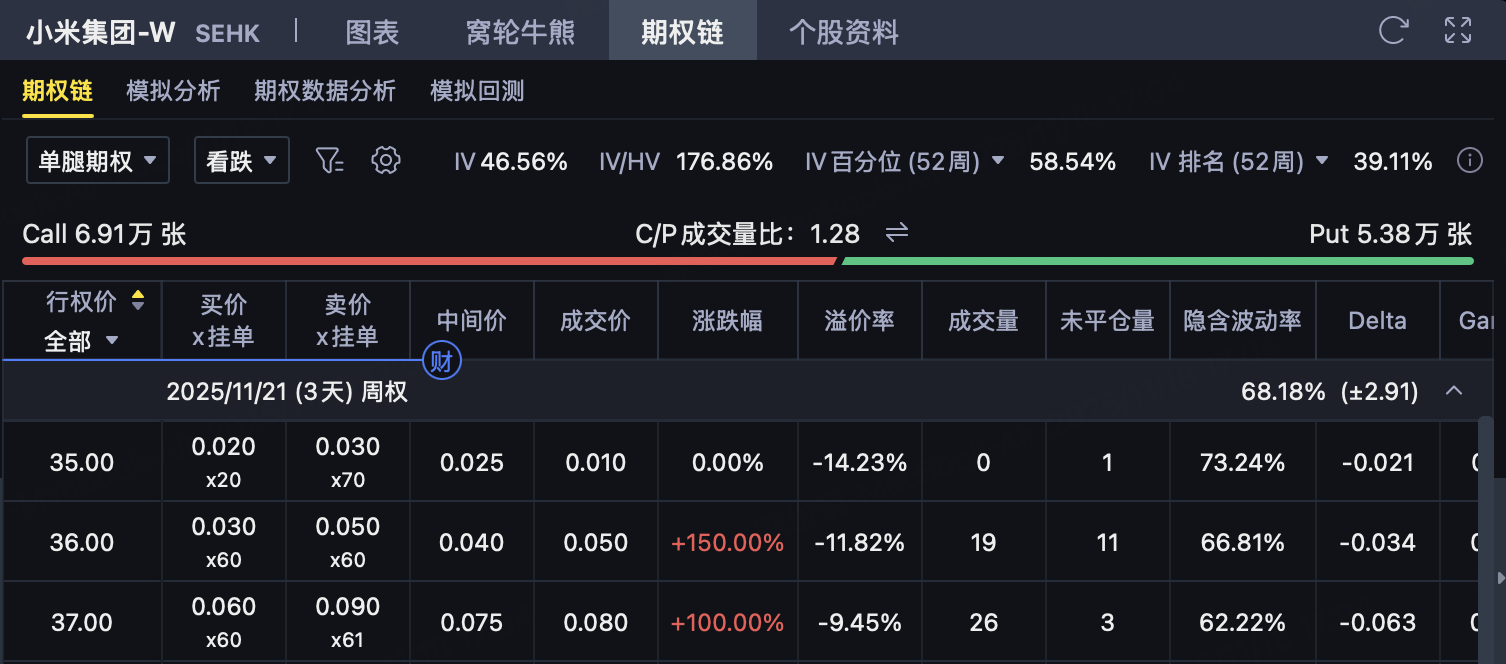
Sell higher strike price Put (sell collect premium): K ₂ = 37, premium revenueHK $0.08
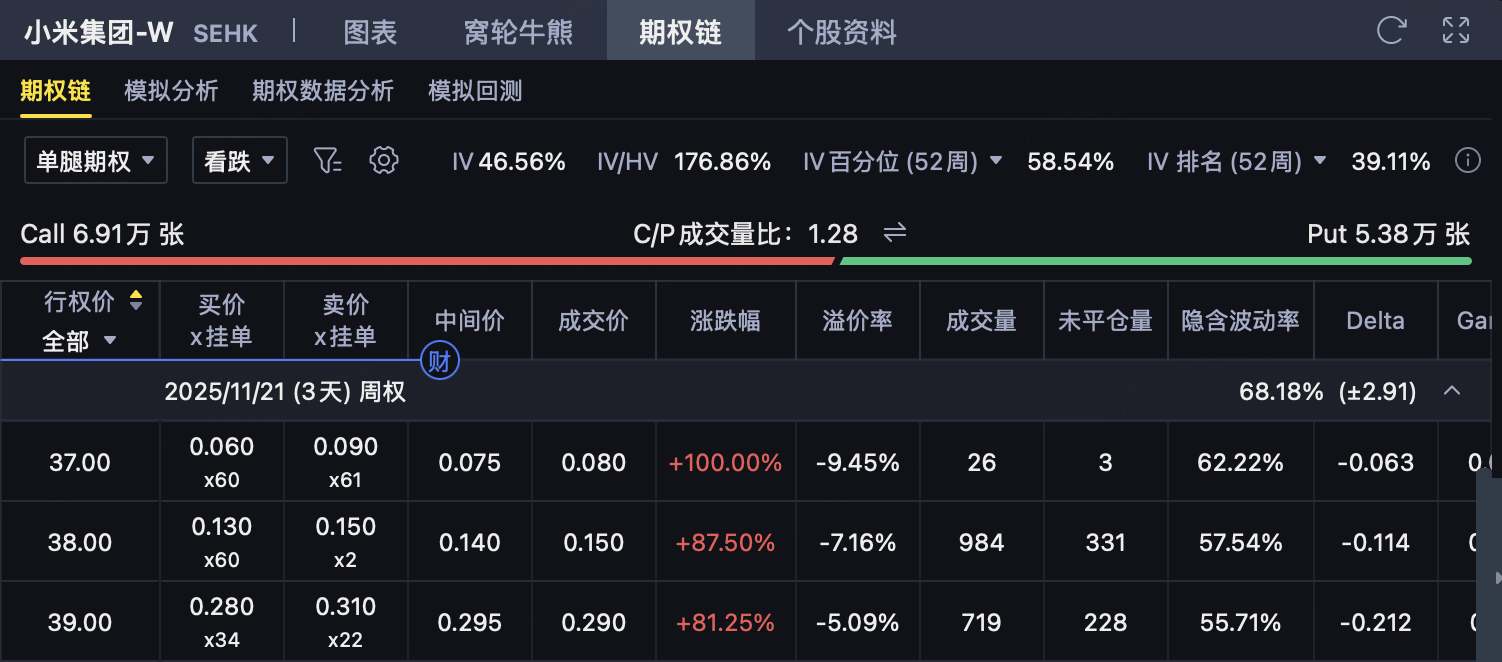
Sell lower strike price Call (sell collect premium): K ₃ = 43, premium revenueHK $0.27
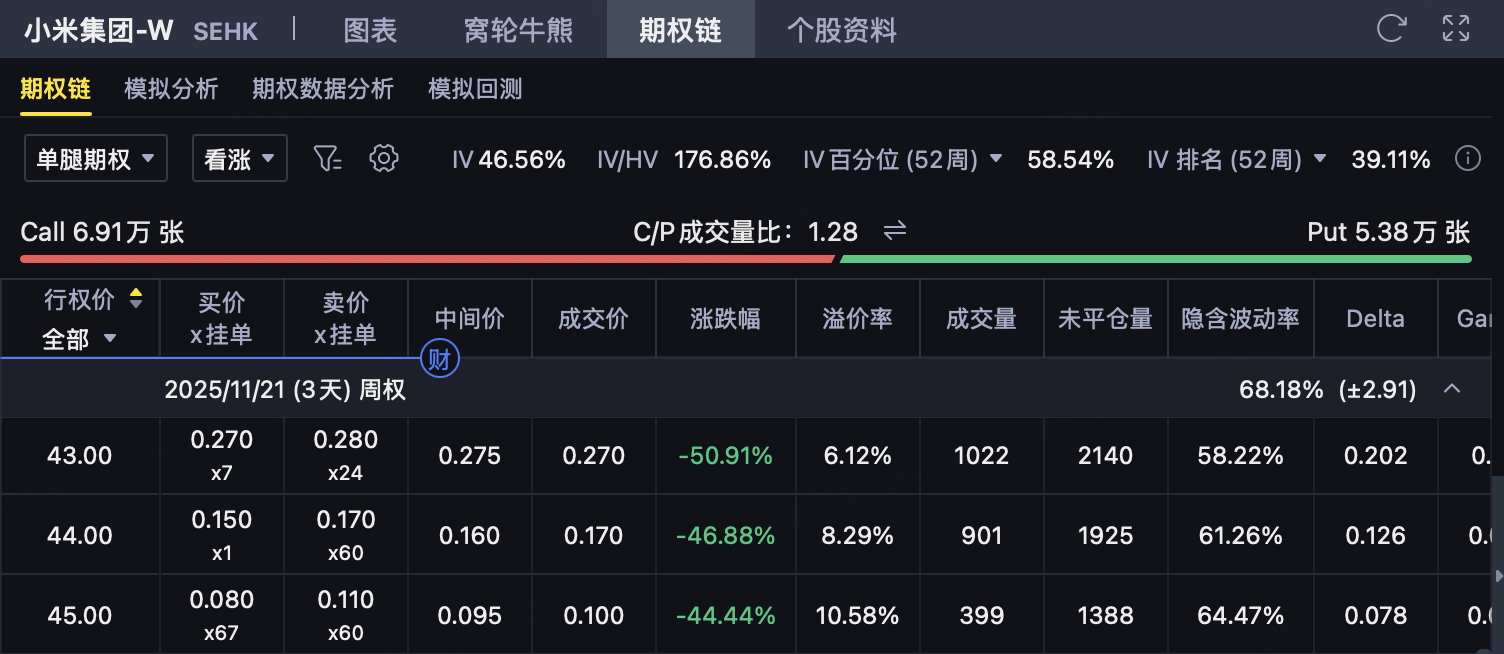
Buy Higher Strike Price Call (Protective): K ₄ = 45, premium expenditureHK $0.10
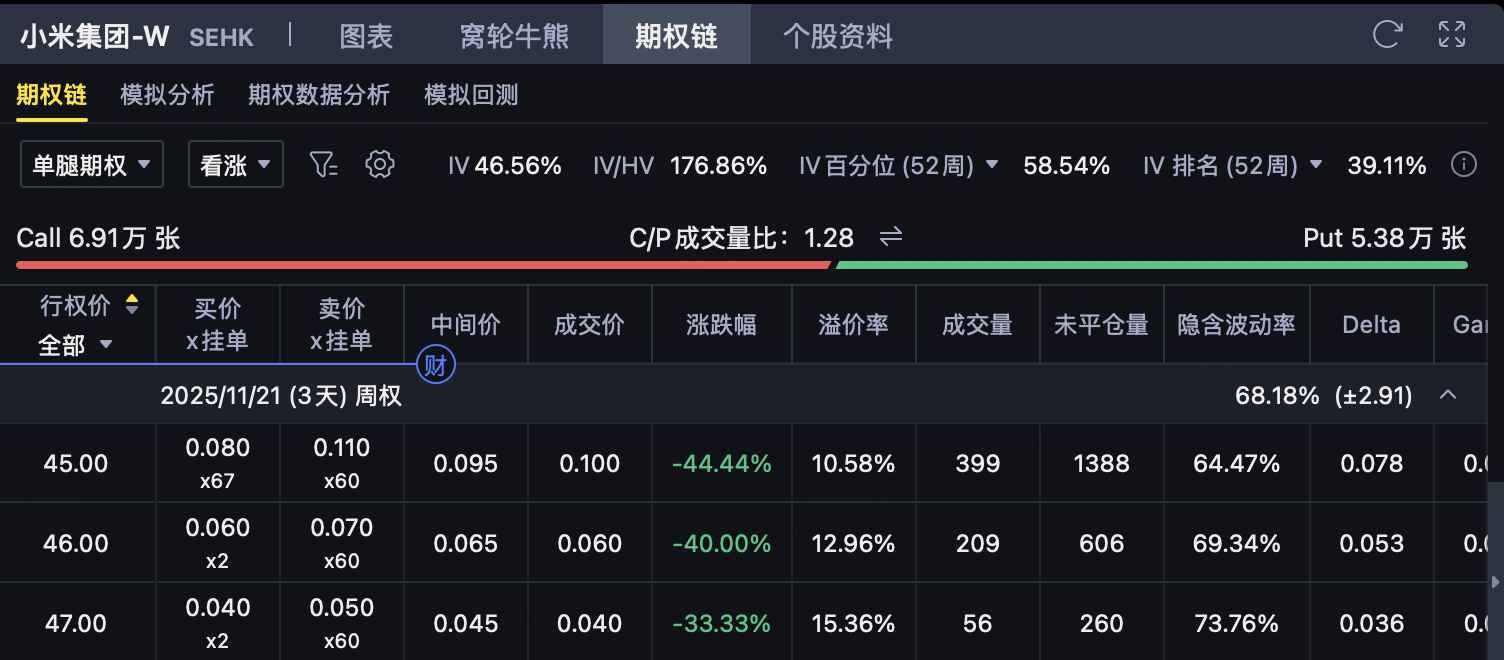
Initial net income
Net premium revenue = revenue from selling Put (37) + revenue from selling Call (43) − expense from buying Put (35) − expense from buying Call (45) = 0.08 + 0.27 − 0.01 − 0.10 =HK $0.24/share
Corresponding total income (1 contract = 100 shares): 0.24 × 100 =HK $24/contract
These 24 Hong Kong dollars are available to investors when opening a positionMaximum potential profit(If the expiration is in the middle range).
3. Maximum profit
If Xiaomi's expiration price falls atBetween HK $37 and HK $43, the four options will not cause a net loss, and investors can retain all net premium income:
Maximum profit =HK $0.24/share
Corresponding total profit =HK $24/contract
4. Maximum loss
The two spreads have the same width:
Put end spread width = 37 − 35 =HK $2Call end spread width = 45 − 43 =HK $2
The largest loss occurs at the stock price≤ HK $35(Put end is full) or≥ HK $45When (Call end is full):
Maximum Loss = Spread Width − Net Income = 2 − 0.24 =HK $1.76/share
Corresponding total loss: 1.76 × 100 =Port 176Currency/Contract
5. Break-even point
Below break-even point = strike price for selling Put − net income = 37 − 0.24 =HK $36.76
The upper break-even point = the strike price of selling Call + net income = 43 + 0.24 =HK $43.24
Therefore, the profit range of investors is:HK $36.76 ≤ Xiaomi due price ≤ HK $43.24。 If you exceed this range, you will begin to lose money.
6. Risk and return characteristics
Maximum benefit:HK $24/contract(limited)
Maximum loss:HK $176/contract(limited)
Profit-loss ratio (by amount) ≈1: 7.33(Maximum gain: Maximum loss)
Applicable scenario: Investors expect millet prices to beHK $37-43The range fluctuates within a narrow range, and hopes to exchange smaller premium for range returns.
Strategy positioning:Neutral to volatile, limited gains but limited lossesInterval return strategy.
Engage and Win Options Rewards!
Share your thoughts on options trading or the market in the comments below.
10 lucky participants will each receive a free copy of the Options Handbook!
Already have one, you’ll get a USD 5 Options Voucher instead!
The Options Handbook takes you from the fundamentals to advanced strategies, helping you gradually build your own trading system. You’ll also gain insights from 10 top traders, and learn how to avoid common options trading pitfalls — making your decisions clearer.
💬 Don’t miss out, drop your thoughts and win your reward!
Disclaimer: Investing carries risk. This is not financial advice. The above content should not be regarded as an offer, recommendation, or solicitation on acquiring or disposing of any financial products, any associated discussions, comments, or posts by author or other users should not be considered as such either. It is solely for general information purpose only, which does not consider your own investment objectives, financial situations or needs. TTM assumes no responsibility or warranty for the accuracy and completeness of the information, investors should do their own research and may seek professional advice before investing.
