


IBM Q3: A Tale of Two Cities? AI Soars to $9.5B, But Red Hat Cools Off.
The global tech transformation has entered a new phase centered on generative AI and data compliance. $IBM(IBM)$ delivered a Q3 2025 report card marked by both strengths and concerns. The company delivered better-than-expected revenue and EPS while raising its full-year revenue and free cash flow guidance. However, growth in its key high-margin software business—particularly the hybrid cloud segment represented by Red Hat—has slowed, becoming the core point of divergence in short-term market sentiment.
Specifically, IBM reported revenue of approximately $16.33 billion for the period, with adjusted earnings per share exceeding expectations. Its "AI book of business" has reached nearly $9.5 billion, with hardware/infrastructure (led by the z series) serving as a key driver this quarter. However, software growth slowed to around 14% from 16% in the previous quarter, creating a gap between market expectations and the company's high-growth projections.
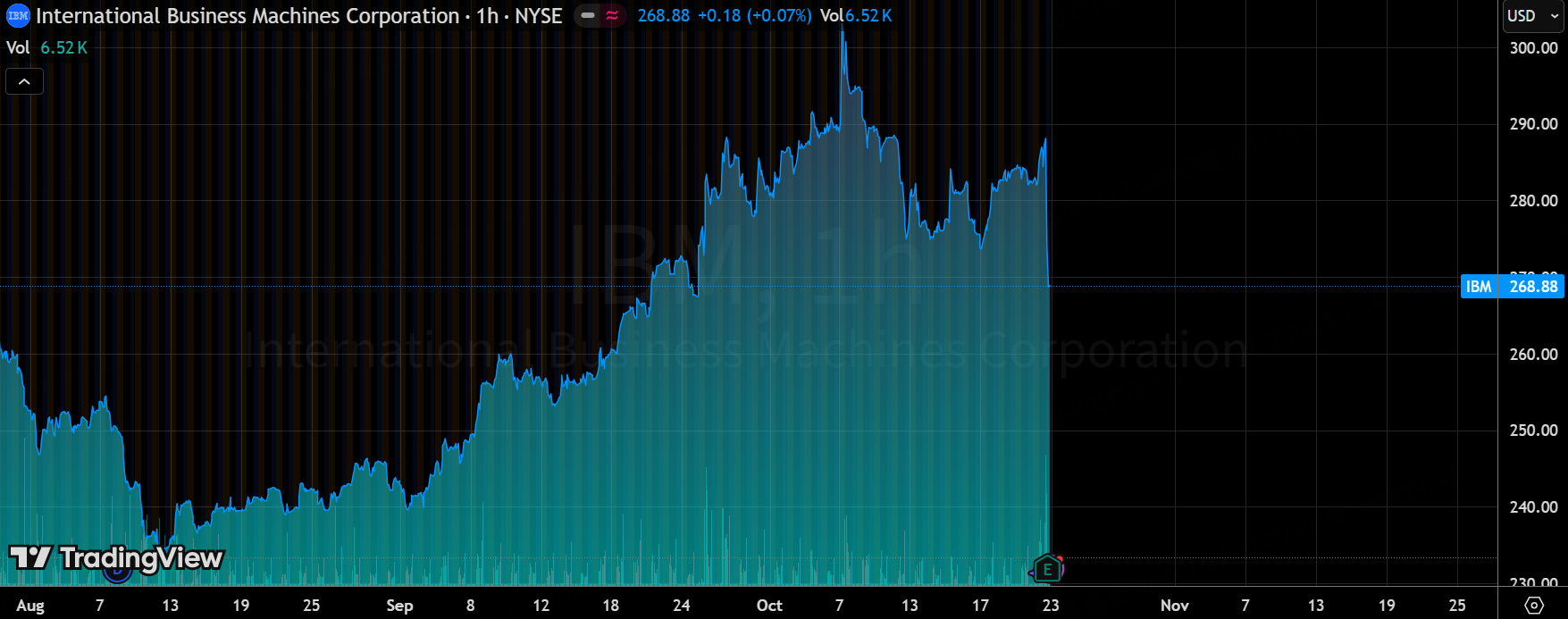
The market remained divided in after-hours trading, acknowledging IBM's earnings and upward guidance revisions (revenue growth >5%, FCF guidance raised) while expressing concerns over Red Hat's short-term slowdown. This led to post-market volatility (a 6% decline), reflecting market caution about whether sustained high growth can be delivered.
Key Financial Highlights
The company's revenue and adjusted EPS exceeded consensus estimates, with growth driven by AI and infrastructure initiatives. However, slowing software revenue growth is holding back valuation premiums.
Revenue: $1.633 billion, up 9% year-over-year (approximately 5% quarter-over-quarter growth) This figure exceeded market consensus expectations ($1.609 billion), primarily driven by robust growth in software and infrastructure businesses fueled by AI demand. Software accounted for approximately 40% of revenue, while infrastructure contributed 25%. The outperforming results stemmed from accelerated adoption of AI-related products like Red Hat and Watsonx. Structural shifts indicate that total orders for generative AI have surpassed $9.5 billion, with its share of overall revenue increasing—signaling the company's transition from traditional IT services to AI platforms.
Adjusted earnings per share (EPS): $2.65, up 15% year-over-year (approximately 10% quarter-over-quarter). This significantly exceeded analyst expectations ($2.45), driven by overachievement in productivity savings initiatives ($4.5 billion annualized savings) and margin expansion (adjusted EBITDA margin up 290 basis points). While this metric fell short of some aggressive forecasts, it remains robust overall. The key driver was a 420-basis-point expansion in infrastructure gross margin, reflecting increased contributions from high-margin mainframes (e.g., IBM Z grew 59%) and a strategic shift toward higher-value segments.
Free cash flow: $2.4 billion for the quarter, $7.2 billion for the first nine months of the year (significant year-over-year growth) reached a record high for the same period, driven by improved operational efficiency and optimized debt management (debt balance of $63.1 billion, cash position of $14.9 billion). Outperformance supports dividend payouts (USD 4.7 billion in first nine months); structural shifts reveal annual recurring revenue (ARR) reaching USD 23.2 billion, up 9%, with increased reliance on high-retention subscription models reducing dependence on one-off projects.
Cloud revenue growth: 14% (year-over-year) Though slower than the previous quarter's 16%, it remains above market averages. This reflects enterprise customers' cautious investment in hybrid cloud solutions. While weaker than some optimistic consensus estimates, AI-integrated cloud services (such as OpenShift ARR growth of 30%) show positive signs. Within the business structure, cloud now accounts for over 30% of revenue, though the deceleration in growth may signal demand volatility influenced by macroeconomic conditions.
The outlook for the full year 2025 is relatively optimistic, with revenue growth projected to exceed 5% (at constant currency) and free cash flow expected to reach approximately $14 billion, surpassing previous guidance. This guidance is characterized as "neutral to aggressive," as actual Q3 growth already reached 7% (at constant currency). The upward revision reflects confidence in the sustained momentum of AI demand, while acknowledging that macroeconomic uncertainties could impact the consulting business.
Key Investment Considerations
The overall strategy focuses on expanding growth through the AI product portfolio.
Management emphasized that the AI product portfolio and the zSeries mainframes targeting industries—particularly those with stringent compliance and security requirements like finance—have generated significant infrastructure demand. Meanwhile, consulting/services have also been driven by AI project implementation and customization needs.
Overall performance reflects a combination of "steady recovery + AI-driven growth," but the slowdown in the high-margin software business (Red Hat) limits the company's long-term potential for sustained high growth. Short-term valuations require repeated validation against the actual performance trajectory.
Software (including Red Hat/hybrid cloud) has a large market size but shows signs of slowing growth.
Software revenue reached approximately $7.21 billion, marking a year-over-year increase of about 10%. Red Hat's growth rate slowed to around 14% from 16% in the previous quarter. Software remains the high-margin core business, but its near-term growth has moderated from the mid-to-high double digits seen last quarter. It remains to be seen whether it can return to mid-to-high double-digit growth in the coming quarters.
Management stated during the call that when customers migrate core applications to the cloud or transform them into AI-native applications, the project cycles and delivery complexity are relatively high, leading to seasonal and execution variations in software licensing/subscription patterns. Meanwhile, Red Hat's enterprise-level migration continues to progress, but will be impacted in the short term by the scheduling of large-scale projects.
Software serves as a critical core engine with high barriers to entry and high profit margins; however, any disruption in the transition from consulting and delivery to ongoing subscriptions can suppress the long-term expansion of a company's valuation.
Infrastructure and hardware (IBM Z/AI mainframe) emerged as the highlight of the quarter.
Strong demand for infrastructure shipments and high-end mainframes directly drove revenue growth this quarter. Infrastructure revenue reached approximately $3.56 billion, up ~17% year-over-year; notably, IBM Z (mainframe) saw significant growth (media reports highlighted the z series' 61% year-over-year increase from a high base).
The CEO and management team repeatedly emphasized during the call the demand for local/securely controllable computing resources to handle AI workloads. Particularly in industries like finance, preferences for data sovereignty, compliance, and low-latency computing have driven significant incremental purchases of high-end infrastructure such as the z series.
The recovery in hardware sales benefits short-term cash flow and profits, but the long-term sustainability of the hardware business depends on embedding software/platforms and transitioning to a service-oriented model.
The Key to the Delivery Rhythm of Consulting and Professional Services
The consulting segment continues to be driven by AI and migration projects, showing a clear recovery in volume growth. However, attention should be paid to gross profit margins and expense ratios.
Consulting services have shown a recovery in revenue composition, with intensive engineering work on client AI implementations. As large enterprise clients transition from proof-of-concept to large-scale deployment, they require higher levels of system integration and industry-specific solutions, driving short-term growth in consulting revenue and cash flow. Management also highlighted the company's ongoing investments in delivery capabilities and talent expansion. However, if delivery efficiency or profit margins are eroded by compensation/recruitment costs, this could weaken the business's contribution to overall profitability.
Valuation Analysis
IBM currently trades at a P/E ratio of approximately 20x (based on annualized Q3 EPS), implying an annual growth expectation of 8-10%, consistent with guidance. However, the market pricing appears largely fully priced, particularly as the AI narrative has been largely priced in (GenAI orders are impressive, but conversion rates warrant observation). Compared to peers like Oracle (P/E 25x, faster AI cloud growth) and Microsoft (P/E 35x, cloud-dominant), IBM appears relatively undervalued for its stable cash flow from infrastructure (e.g., mainframes). However, lagging cloud growth could indicate overpricing. This may imply a margin of safety near the $200 price level. Should AI order conversions exceed expectations, valuation expansion remains possible. If IBM can re-accelerate Red Hat's growth to management targets over the next 2-3 quarters, the market may recognize its valuation premium; otherwise, it may discount the sustainability of its growth trajectory.
Disclaimer: Investing carries risk. This is not financial advice. The above content should not be regarded as an offer, recommendation, or solicitation on acquiring or disposing of any financial products, any associated discussions, comments, or posts by author or other users should not be considered as such either. It is solely for general information purpose only, which does not consider your own investment objectives, financial situations or needs. TTM assumes no responsibility or warranty for the accuracy and completeness of the information, investors should do their own research and may seek professional advice before investing.
- Enid Bertha·2025-10-23Solid quarter overall. No reason for the stock to drop unless shorted to buy lower.LikeReport
- Valerie Archibald·2025-10-23Great dividend solid companyLikeReport
- snugglo·2025-10-23Sounds like a mixed bag for IBM.LikeReport
- zippy1·2025-10-23Impressive insights and analysis! 🔍👏LikeReport