• 969
  • 106
  • 9

The S&P 500 Narrowly Averts a Bear Market. How Long Do They Last Once They Arrive?

MarketWatch2022-05-21

Average bear market lasts a little under a year: LPL Financial
Joe Raedle/Getty Images

The S&P 500 averted a bear market Friday, trimming losses to finish flat after trading solidly below a key threshold. But history shows that when a bear arrives, it tends to stick around awhile.

The large-cap U.S. benchmark ended the session with a gain of less than a point at 3,901.36 after trading as low as 3,810.32. A close below 3,837.25 would mark a 20% pullback from the S&P 500's Jan. 3 record finish, meeting the traditional definition of a bear market, according to Dow Jones Market Data.

The Dow Jones Industrial Average erased a 617 point loss to end the day at 31,261.90. A finish below 29,439.72 would put the blue-chip gauge into a bear market.

To be sure, many investors and analysts see that 20% definition as an overly formal if not outdated metric, arguing that stocks have been behaving in bear-like fashion for weeks.

And note, that if the S&P 500 were to close below the threshold in the coming days, the start of the bear market would be backdated to the Jan. 3 peak. A bear market is declared over once the S&P 500 has risen 20% from a low.

OK, so what does history say about what happens once a bear market begins?

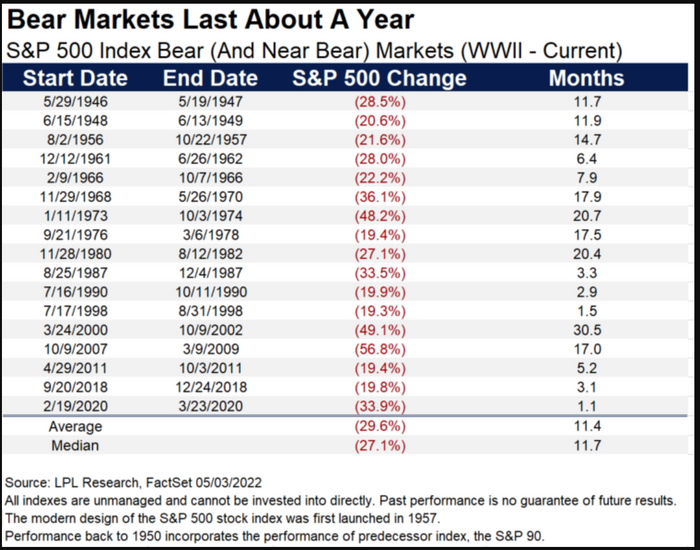
There have been 17 bear --- or near-bear--- markets since World War II, said Ryan Detrick, chief market strategist for LPL Financial, in a Wednesday note. Generally speaking, the S&P 500 has fallen further once a bear market begins. And, he said, bear markets have, on average, lasted about a year, producing an average peak-to-trough decline of just shy of 30%. (see table below).
LPL Research

The steepest fall, a peak-to-trough decline of nearly 57%, occurred in the 17 months that marked the 17-month bear market that accompanied the 2007-2009 financial crisis. The longest was a 48.2% drop that ran for nearly 21 months in 1973-74. The shortest was the nearly 34% drop that took place over just 23 trading sessions as the onset of the COVID-19 pandemic sparked a global rout that bottomed out on March 23, 2020, and marked the start of the current bull market.

The S&P 500 neared bear territory last week before a strong Friday-the-13th bounce that halved its weekly losses. Another strong bounce was seen May 17, but gains were more than erased in the following session after downbeat results from retailing giant Target Corp. underlined fears that inflation pressures were beginning to take a toll on margins.

The earnings from Target and, a day earlier, Walmart Inc. "have me concerned that bad things may be starting to happen in the U.S. economy," said Tom Essaye, founder of Sevens Report Research, in a Thursday note.

"Namely, that the length of high inflation has infiltrated the lower income cohorts of the economy, and they are now reacting, quickly. And as inflation stays high and the economy slows, that will creep 'up' the income distribution, and the concern is the margin issues TGT and WMT are facing will spread to other parts of the retail space and the market more broadly," Essaye wrote.

Mike Mullaney, director of global markets research at Boston Partners, worries that Wall Street analysts have yet to catch up to the danger. While earnings expectations for companies in emerging markets and the broader developed-markets indexes have turned down, that isn't the case for the S&P 500, he noted, in a Thursday interview.. That indicates that the analysts covering the S&P 500 are "behind the curve," which could be one of the last shoes that has to drop, he said.

Disclaimer: Investing carries risk. This is not financial advice. The above content should not be regarded as an offer, recommendation, or solicitation on acquiring or disposing of any financial products, any associated discussions, comments, or posts by author or other users should not be considered as such either. It is solely for general information purpose only, which does not consider your own investment objectives, financial situations or needs. TTM assumes no responsibility or warranty for the accuracy and completeness of the information, investors should do their own research and may seek professional advice before investing.

Report

Comment106

  • tig2021
    ·2022-05-23
    Ok
    Reply
    Report
  • KH321
    ·2022-05-23
    OK
    Reply
    Report
  • robot1234
    ·2022-05-23
    The global business elite will gather in the mountains of Davos, Switzerland this week amid a backdrop of turbulent markets and an uncertain economic outlook. For the first time in over two years, CEOs, politicians, and billionaires are set to congregate at the World Economic Forum following a pandemic-induced hiatus. Russia’s war in Ukraine, the COVID-19 pandemic, and worries of economic gloom will be among the key topics discussed, as the world's top leaders face the most uncertain outlook for global cooperation in years. A top-of-mind issue for many Davos attendees will no doubt be recent turbulence in financial markets, as the S&P 500 just completed its seventh consecutive week of losses, the longest streak since 2001. The benchmark index has fallen seven weeks in a row only twice
    Reply
    Report
  • DarkRaven
    ·2022-05-23
    Ok
    Reply
    Report
  • Sunshine_2
    ·2022-05-22
    OK
    Reply
    Report
  • AuntieAaA
    ·2022-05-22
    OKAY
    Reply
    Report
  • VivianChua
    ·2022-05-22
    Will rebound 💚
    Reply
    Report
  • 来人
    ·2022-05-22
    Ok
    Reply
    Report
  • wayjay1159
    ·2022-05-22
    How long will the next bear market last?
    Reply
    Report
  • nanehz07
    ·2022-05-22
    Like
    Reply
    Report
  • HBONG
    ·2022-05-22
    pls like, thks
    Reply
    Report
  • LimLS
    ·2022-05-22
    We can see other than the 2 major crash on the 2000, 2008, most of the other declines are lesser than 30%. So if we think this crash will be a minor crash, the SP500 should bottom around 3350. We can plan our entry based on this. But if the crash is a major one, going to 2400-2900 will be possible. While we can't predict will the crash will be major or minor, we can try to guess if Fed will allow the market to crash so much. Based on their recent statement, we know Fed is resolved to bring down inflation. At this level (20% down), Fed still issued such determined statement. So most likely even with another 10% down, Fed will still continue their hikes and QT. Do not expect Fed to save the market unless it is a major crash where S&P 500 goes well below 3000. So market still have some ro
    Reply
    Report
  • IAS
    ·2022-05-22
    With US and China's economy clearly slowing, risk for recession is really high. Thus risk of bear market is obvious too. We have to trade/invest with caution. 
    Reply
    Report
  • Ryanlmh
    ·2022-05-22
    K
    Reply
    Report
  • Steve81
    ·2022-05-22
    Jiayou
    Reply
    Report
  • Steve81
    ·2022-05-22
    Jiayou
    Reply
    Report
  • Vincent1968
    ·2022-05-22
    Like
    Reply
    Report
  • HTChin
    ·2022-05-22
    Why 20% definitions??? Not 30%, 40%,50%...this is just a guessing game, end of the day it is up to Wall Street big guys to decide whether the stock market is up or down. 
    Reply
    Report
  • ericbqlee
    ·2022-05-22
    🙂
    Reply
    Report
  • vSup_puSv
    ·2022-05-22
    Like pls 
    Reply
    Report


Most Discussed


7x24