


Roughly three months after an embarrassing reversal on the efficacy of its Covid-19 antibody against the Omicron variant, the small-cap biotech Adagio Therapeutics is back with new data, and says it will proceed with asking the Food and Drug Administration to authorize its drug.
Adagio says that the drug, ADG20, reduced the risk of Covid-19 by 71% when given as a pre-exposure prophylaxis, and 75% when given as a post-exposure prophylaxis. As a treatment to patients with mild to moderate Covid-19, it reduced the risk of hospitalization and death by 77%.
The drug’s Omicron problems, however, don’t seem to have been resolved. Nearly all of the data was collected before the Omicron variant, and the data collected amid Omicron appears to show a weaker benefit than the other results. The company’s struggles highlight the weaknesses of monoclonal antibody therapies overall as a tool against Covid-19—something the Omicron variant revealed.
The company acknowledged in its Wednesday statement that the trials were “primarily conducted” before the emergence of Omicron as the dominant variant in the U.S.
Adagio said it will seek an emergency use authorization for ADG20, also known as adintrevimab, for prevention and treatment of Covid-19 in the second quarter.
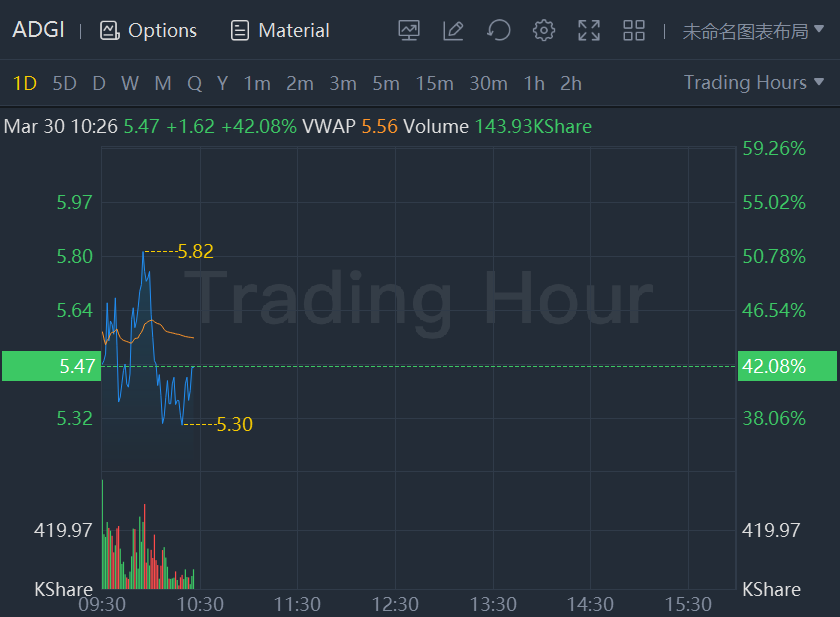
Shares of Adagio (ticker: ADGI) rose as much as 72.9% in premarket trading Wednesday to $6.62, from Tuesday’s closing price of $3.85. That spike moderated slightly as the morning progressed, and the stock was up about 42%, to $5.47, at 10:25 a.m.
Shares closed as high as $47.04 in November, when the company issued a release in which it claimed that ADG20 would protect against the Omicron variant, based on its understanding of how ADG20 binds to the virus that causes Covid-19. Laboratory data released in December, however, didn’t support those claims.
Shares plunged by 78.8% in a single day in mid-December after the company announced the results of its lab tests. The reversal was followed months later by the resignation of the company’s CEO. Adagio is currently being led on an interim basis by its former chief operating officer, David Hering.
Hering, said in Wednesday’s statement that he was “optimistic about the road ahead.” But it’s not at all clear that Adagio has gotten over its Omicron problem.
Data from one portion of the trial conducted after the emergence of Omicron is not as strong as the pre-Omicron data. An exploratory analysis after the emergence of Omicron followed 402 participants who received ADG20 as a pre-exposure prophylaxis, and found that the relative risk reduction in the group who received the treatment compared to the placebo group was 47% after 77 days. Before Omicron, the relative risk reduction as a pre-exposure prophylaxis was 71% after three months.
“We are encouraged by the data and look forward to submitting an EUA and discussing these results with the FDA and other regulatory authorities,” said Adagio’s chief development officer, Ellie Hershberger, in a statement.
The company’s struggles with Omicron offer yet another example of the shortcomings of monoclonal antibodies as a tool against a fast-changing virus like SARS-CoV-2. Last week, the FDA limited the use of sotrovimab, a Covid-19 monoclonal antibody therapy from GlaxoSmithKline (GSK) and Vir Biotechnology (VIR), after studies showed that it was likely not effective against the Omicron subvariant BA.2.
That came just months after the FDA revoked authorizations of other available monoclonal antibody therapies, which hadn’t worked against the original Omicron variant.
Adagio did not mention ADG20’s efficacy against BA.2 in its news release. Last week, the journal Nature Medicine published a paper that found that ADG20, along with many other antibody therapies, was “inactive” against BA.2.
Also on Wednesday, Adagio announced full-year financial results for 2021, saying it had $591.4 million in cash and cash equivalents as of the end of 2021, enough to fund its operations through the second half of 2024.