


If you hold an “emerging markets” stock fund in your IRA or 401(k), it’s been a white-knuckle few days.
Emerging markets tanked after China’s Communist governmentcracked down on some of the country’s tech giants. Chinese stocks dominate the emerging market indexes these days, accounting for about 40% of the typical fund.
Widely held funds like the Vanguard Emerging Markets Stock FundVEMAX,-0.98%and its ETF equivalentVWO,-0.68%,iShares Core MSCI Emerging MarketsIEMG,-0.88%and iShares MSCI Emerging MarketsEEM,-0.96%lost 5% of their value in a few days, though they’ve since rallied.
That’s left them down about 5% since the start of the quarter on July 1 (American Funds’ actively managed New World fundNEWFX,-1.08%has held up better, and is down 2.5%)
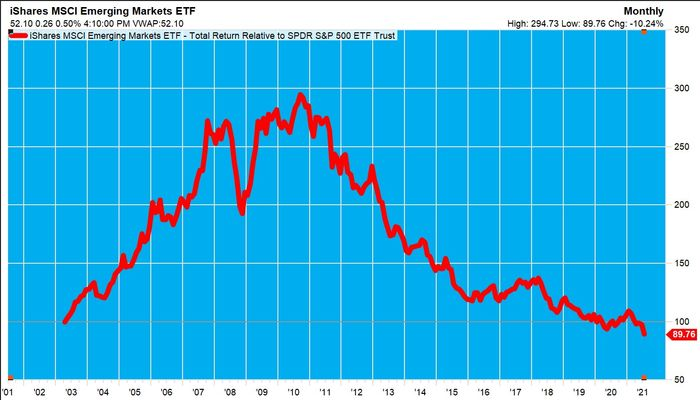
More important for long-term investors, this comes after a pretty dismal decade for emerging markets. Even factoring in reinvested dividends, the typical EM stock fund has banked a total return of 35% over the past 10 years.
Over the same period an investor in the S&P 500 U.S. stock indexSPX,-0.54%,for example through the SPDR S&P 500 TrustSPY,-0.49%,has gained over 300%.
With that in mind, does the typical saver even need, or want, an emerging markets fund in their 401(k) or IRA?
Ian Weinberg, a financial planner at Family Wealth & Pension in Woodbury, N.Y., gives the case against. Emerging markets—and even developed international markets such as Europe and Japan—give you more risk and less return, he says. “Foreign equities have high correlation to U.S. equities in falling U.S. markets, and then have lower correlation to U.S. markets when they are rising,” he tells me. “That means simply that foreign stocks have begun to provide poor risk and return characteristics. Would you invest in something that goes down as much or more than domestic stocks, and goes up less than domestics stocks when they’re running?”
Foreign stocks today look cheap compared to the U.S. for a reason, he says: “Europe can’t get out of the current negative interest environment, and emerging markets, dominated by China, are subject to governmental intervention and stability risk.” Meanwhile, U.S. companies all have big overseas exposure anyway, he points out. You can get all the exposure to international growth opportunities through the S&P 500.
He’s not alone. Berkshire Hathaway’sBRK.A,-0.42%BRK.B,-0.53%chairman and investment genius Warren Buffett says most people are probably best off holding 90% of their portfolio in a U.S. stock market index fund and 10% in U.S. Treasury bills.
But it takes two points of view to make a market, and plenty of advisers take the other side of the argument.
“Emerging markets should definitely be a part of any person’s long term allocation,” says financial planner Ken Nutall in West Grove, Pa. Emerging markets tend to “zig” when other markets “zag,” he says. Emerging markets also offer a lot of possible growth. “They do tend to be a volatile but over longer periods they do tend to outperform,” he says.
“Ordinary investors should absolutely have a weighting toward emerging markets within their long-term investment strategy,” agrees Jay Karamourtopoulos, a financial planner in Boston. “While global economies are now more connected than ever, there are still diversification benefits to investing in emerging markets,” he says. He adds: “Most investors have a home country bias to begin with. Couple that with the strong U.S. returns over the past decade and an argument can be made that many individual investors are severely overweight domestic stocks.”
“Yes, of course people should be invested in emerging markets,” agrees planner Chris Chen in Lincoln, Mass. “It is part of diversification.” China, he says, is the second largest economy in the world and will soon be the largest. “How do you ignore them?”
And many advisers say that one reason to look more closely at foreign markets—including emerging markets, and developed markets such as Europe—right now is precisely because they have done so badly for a decade. Emerging market stocks have underperformed U.S. stocks over the past decade, says planner Robert Cheney in Palo Alto, Calif. But that means “emerging markets are [now] cheaper on a relative value basis…and there may be a reversion to the mean over the next decade.
“Emerging markets in general have had a tough time over the last 10 years,” says planner Brian Fischer in Miami. “However,” he adds, “there have been individual years recently and other stretches historically where they’ve relatively done much better. There is a diversification benefit, it’s just timing that benefit is incredibly difficult.”
Those shying away from emerging markets because they’d done poorly of late, adds adviser Jordan Benold in Frisco, Texas, might bear in mind “the fundamental philosophy of buying low and selling high.”
For my own part, I’ve been covering financial experts for over two decades and these things seem to have gone in cycles. I remember back in 2010, when emerging markets were on top, mainstream opinion was cheering them aggressively. If the cycle turned again, I wouldn’t be surprised.
A big challenge today is that China so completely dominates emerging markets that your typical EM fund isn’t really that diversified. Add to that the issue that China is a rigged market controlled by the Communist Party (and the risks China may pose to Taiwan, by the way). Planner Chris Chen sees merit in splitting out China and non-China emerging markets as separate allocations. This makes a lot of sense.
Franklin Templeton offers a China ETFFLCH,-0.41%with a moderate 0.19% annual charge. BlackRock’s iShares offers an emerging markets fund that excludes China, iShares MSCI Emerging Markets ex China ETFEMXC,-1.36%,charging 0.25% a year. It’s top country holdings are 22% Taiwan, 21% South Korea, 16% India and 9% Brazil.
Joachim Klement, strategist at Liberum and a top research figure at the CFA Institute, says that the most truly diversified stock portfolio is one that follows, not the U.S. or any other country or region, but the MSCI All-Country World IndexACWI,-0.56%,which includes the U.S., Europe, Japan, Australasia, emerging markets and everywhere else. That, incidentally, is the strategy of some low-cost exchange-traded funds such as the Vanguard Total World Stock ETFVT,-0.56%and SPDR Portfolio MSCI Global Stock Market ETFSPGM,-0.71%.
Note that they still hold nearly 60% of their money in U.S. stocks (which is about three times the U.S. share of world economic output, according to the IMF) because of U.S. valuations. Meanwhile emerging markets account for a modest 11% of the fund. Make of that what you will.