


Shares of Nvidia fell 1.58% on Friday to close at $180.25. Earlier in the day, reports said Amazon had reached a partnership with AI chip startup Cerebras Systems to integrate their respective computing chips into a new service designed to accelerate chatbots, coding tools and other artificial intelligence applications.
Cerebras, an AI chip startup valued at about $23.1 billion, is attempting to challenge the industry leader by developing AI processors that differ significantly from Nvidia’s flagship architecture.
Meanwhile, Nvidia’s annual Nvidia GTC conference is scheduled for March 16–19, 2026. A keynote from CEO Jensen Huang is drawing particular attention, with expectations that the company will unveil technological advances including its next-generation AI chip platform, Feynman.
Options Indicators Analysis
1. Implied Volatility and Market Sentiment
Nvidia’s options currently carry an implied volatility (IV) of 46.50%, placing it in the mid-to-upper range of its historical distribution (IV percentile: 51.79%). This suggests options pricing is broadly fair but slightly rich.
The IV/HV ratio stands at 1.32, indicating traders are pricing in higher future volatility relative to recent realized moves.
In terms of trading activity, the call-to-put volume ratio stands at 1.56. Meanwhile, the put-to-call open interest ratio for contracts expiring this Friday is 0.73, reflecting a modestly bullish tilt in positioning.
2. Key Open Interest Levels Highlight the Main Battleground
Open interest (OI) data shows that market attention is heavily concentrated around several key strike levels.
$200 Calls dominate positioning. The March 20, 2026 $200 call holds a striking 239,823 contracts in open interest, while the March 27, 2026 $200 call has 47,592 contracts, making the $200 strike the market’s primary focal point. The buildup suggests a large amount of capital either betting on or hedging against the possibility of the stock approaching that level toward quarter-end.
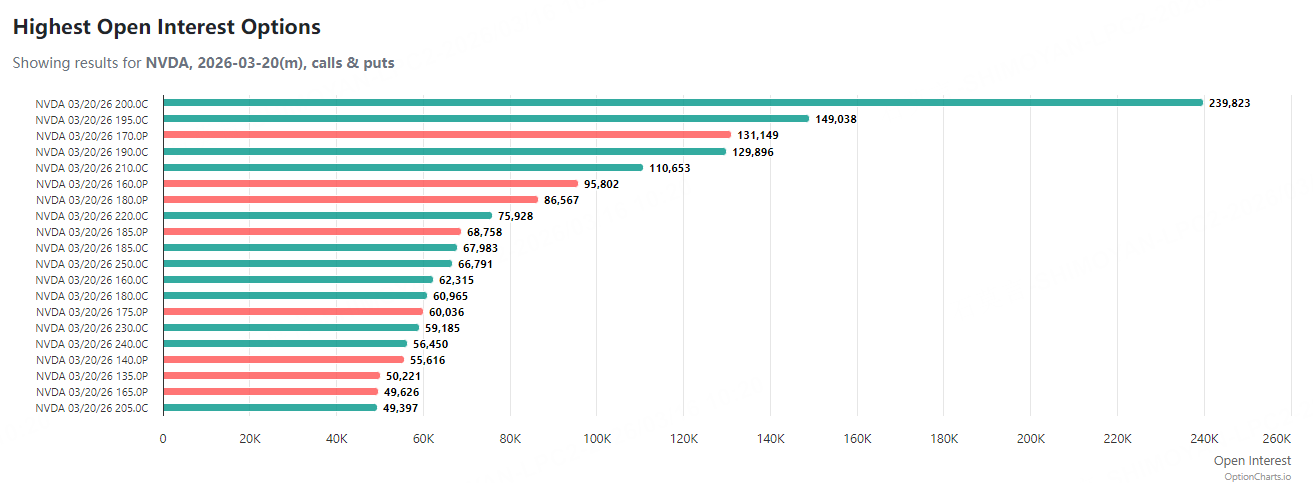
Secondary positioning at $195 Calls. The March 20, 2026 $195 call also shows significant activity, with 149,038 contracts in open interest.
Downside protection around $170. On the put side, the largest open interest sits at the $170 put (131,149 contracts). This level could serve as an important support zone or a potential “sell-put” entry level for investors willing to accumulate shares.
3. Large Block Trades Reveal Institutional Strategy Divergence
Recent large options trades point to notable divergence among institutional investors and the presence of more complex positioning strategies.
Large-scale call selling builds overhead resistance. Multiple block trades totaling more than 30,000 contracts were seen selling the March 20, 2026 $185 calls, alongside a nearly 10,000-contract sale of $200 calls. Such trades suggest that some large investors believe the stock may struggle to break through the $185–$200 range in the near term. By selling calls and collecting premium, these positions effectively create a short-term resistance zone.
Bearish spread positioning. One trader established a 6,000-contract put spread, buying the $250 put and selling the $240 put, expressing the view that the stock is likely to remain below $240 in the near term.
More nuanced calendar strategy. Another trade involved a 3,500-contract put calendar spread—buying the near-term $195 put while selling the longer-dated $185 put. This structure suggests a short-term bearish outlook while maintaining a more neutral stance over the longer horizon.
4. Summary and Strategy Considerations
Key technical levels in the options market appear to be $200 as resistance, driven by heavy call open interest, and $170 as support, supported by substantial put positioning.
With implied volatility in the mid-to-upper historical range, the environment may favor options sellers seeking to harvest time premium. Traders looking to collect premium could consider selling out-of-the-money calls above key resistance levels such as $200, where the probability of assignment is relatively lower.
For investors looking to limit margin exposure, bear call spreads may offer a way to define maximum risk while still benefiting from time decay.
However, the large concentration of call open interest around the $200 strike could prove to be a double-edged sword. Should the stock approach that level, positioning dynamics could potentially trigger sharp volatility through a gamma squeeze.
Disclaimer: This analysis is based on publicly available market data and is provided for informational purposes only. It does not constitute investment advice. Options trading involves significant risk and may not be suitable for all investors.
