


The plunge in U.S. stocks has caused downward concerns, what to do on defense?
Affected by factors such as the intensified risk of trade war and the continued shutdown of the U.S. federal government, market sentiment deteriorated rapidly, and U.S. stocks suffered "Black Friday". Data shows that the S&P 500 Index and the Nasdaq Composite Index closed down 2.71% and 3.56% respectively, both hitting the largest one-day declines since April; The Dow Jones Industrial Average closed down 1.9%.
Market panic is heating up simultaneously. The Chicago Board Options Exchange Volatility Index (VIX), regarded as the "Wall Street panic indicator," surged above 22 at one point on Friday, ending a smooth trend over the past four months. Analysts pointed out that as the automated trading system triggers the stop loss and institutional funds close their positions and leave the market, market volatility is further amplified. From the perspective of market structure, this "technical decline" is often accompanied by a surge in trading volume and panic selling, and may maintain high volatility in the short term.
Investors' fears that the record U.S. stock rally is coming to an end heated up sharply on Friday after tariff risks resurfaced."At current high valuation levels, this sell-off reflects market nervousness," said Gene Goldman, chief investment officer at Cetera Investment Management. "Everything in the market is priced in'perfect 'expectations, so any uncertainty amplifies investor anxiety, which undoubtedly adds to concerns about economic growth."
Technology stocks led the decline in Friday's U.S. stock sell-off. Chip, semiconductor, electric vehicle and other sectors fell across the board, with many leading stocks falling between 5% and 8%. Investors are worried that these industries are not only constrained by the global supply chain in the production process, but the growth expectations of their sales markets are also facing slowing pressure.
Art Hogan, chief market strategist of B. Riley Wealth, pointed out that the valuation of technology companies has been significantly pushed up in the past few months, and in the context of rising external uncertainty, funds naturally choose to lighten up their positions in high-valuation varieties. Art Hogan said: "These companies are highly dependent on the global system on both ends of supply and demand. When the external environment is turbulent, the market will first reprice risks in these stocks."
It is worth mentioning that Jamie Dimon, CEO of JPMorgan Chase, warned this week that the risk of a serious decline in U.S. stocks in the next 6 to 24 months is much higher than the situation reflected by the market, and pointed out that he is far more worried than others about the risk of a sharp market correction.
Dimon said that most of the rise in U.S. stocks is driven by artificial intelligence (AI)-related investments, and the risk of overheating in U.S. stocks is rising. At the same time, a lot of things have caused uncertainty, including geopolitical tensions, fiscal expenditures and global remilitarization. These are questions that no one can answer, so most people think that the market uncertainty is greater. Talking about AI investment, Dimon said that AI investment as a whole will bring returns, but some related investments may face losses. Dimon also reiterated that he is still a little worried about U.S. inflation.
However,Some investors believe that the sudden escalation of Sino-US trade tensions is unlikely to significantly change the market trend, because artificial intelligence is still the dominant factor.James St. Aubin, chief investment officer at Ocean Park Asset Management, said: "This is undoubtedly a significant issue and could also trigger a short-term pullback, but I don't think it will shake the AI theme that is driving the market up."
The chief investment officer of Nuveen Asset Management LLC also previously stated that U.S. stocks are likely to continue their upward trend before the end of the year, and solid corporate profits-especially the performance of ultra-large-scale technology giants-will continue to drive up stock prices. Saira Malik pointed out on Thursday that for the stock market, the fourth quarter "is usually a strong quarter, especially if it has achieved significant gains year-to-date. Therefore, the probability of the current rally continuing is high."
Although this round of gains has made U.S. stock valuations higher than historical levels and triggered market concerns about stock market bubbles, in Saira Malik's view, strong corporate performance is enough to support current valuations. She expects corporate earnings to once again beat market expectations as the third-quarter earnings season kicks off next week. Third-quarter profits of S&P 500 stocks are expected to rise 7.4%, the smallest increase in two years, analyst data showed. Saira Malik said: "If you explore the core drivers of the rise in technology stocks, you will find that it is not mainly driven by valuation improvements, but by earnings growth."
What exactly is the collar strategy?
To protect the downside risk of stocks, there is a strategy of buying put options (Protective Put), and to reduce the cost of holding stocks, you can sell Covered Call options (Covered Call). In order to take care of both, Collar options-this new strategy was born.
The operation method of collar option is to buy an out-of-the-money put option as insurance on the premise of holding stocks, and at the same time sell an out-of-the-money call option to pay the cost of insurance. This is equivalent to putting a Collar on the stock, and the income of the stock is locked in it, hence the name of the Collar option. The collar option is in fact a combination of Protective Put and Covered Call, which limits the risk of downside at the expense of removing some of the possibility of upside profit.
Collar options are available when traders have a bullish position in the underlying market and want to protect the position from market downside. When the full cost of a put option is covered by selling a call option, it is called a zero-cost collar strategy.
Nvidia Collar Options Strategy Case
Let's say an investor owns 100 shares now at $183$Nvidia (NVDA) $, investors are not sure how prices will change in the near future and want to buy an insurance policy for their positions. You can use the collar strategy.
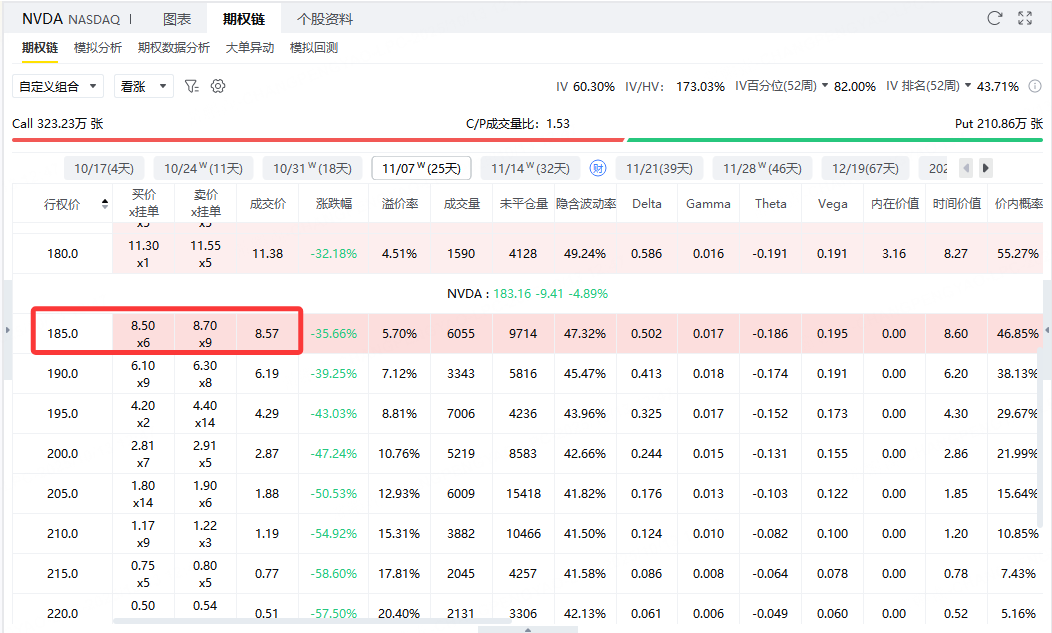
In the first step, investors can sell a call option with an exercise price of $185 and an expiration date of November 07, earning $857.
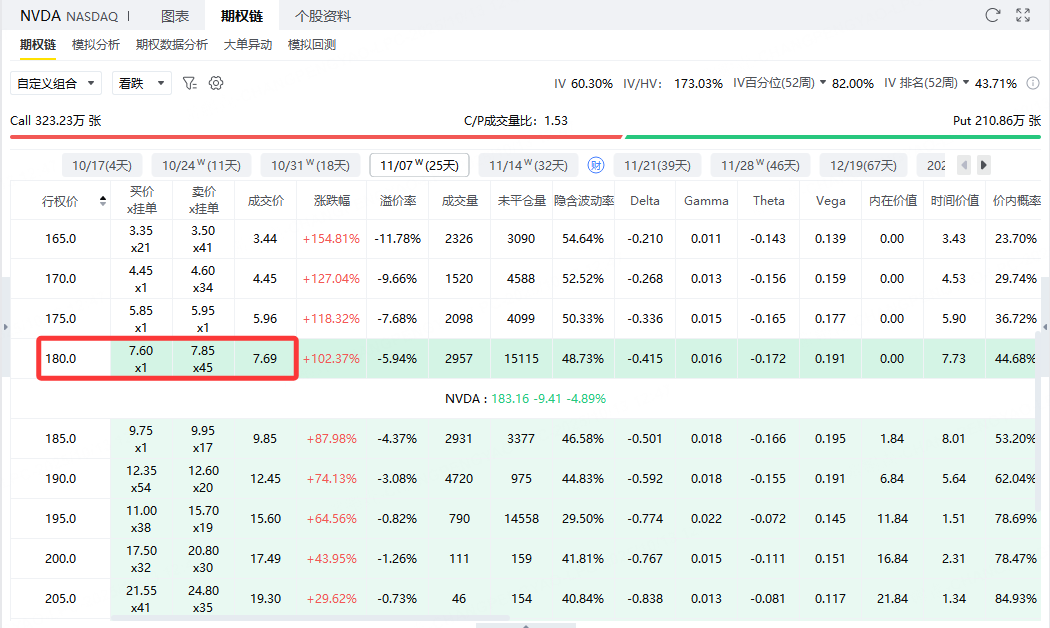
In the second step, you can also buy a put option with an exercise price of $180 and an expiration date of November 07 at a price of $769.
This strategy can play a protective role when Nvidia's stock price falls sharply, while earning premium income by selling call options and reducing the cost of buying insurance.
Operation steps:
Sell Call Option (Covered Call)
Strike price: $185
Due: 07-Nov-2025
Revenue premium: $857
Buy a put option (Protective Put)
Strike price: $180
Expiry Date: 07 November 2025
Pay premium: $769
Strategy costs/benefits
Net premium income= Sell Call-Buy Put = 857-769 =$88(i.e. slight revenue)
Maximum downside risk= Strike price $180-Current stock price $183-Net income $88 ≈Loss less than $3/share
Maximum upside earnings= Strike price $185-Current stock price $183 + Net income $88 ≈Earnings ~ $5/share + $88 premium
Profit and loss characteristics
Stock price drops below $180, protective put limits losses
Stock price rises above $185, call option is striked, gains locked in
The stock price is in the $180-$185 range, and the strategy makes a small profit (affected by net premium)
Disclaimer: Investing carries risk. This is not financial advice. The above content should not be regarded as an offer, recommendation, or solicitation on acquiring or disposing of any financial products, any associated discussions, comments, or posts by author or other users should not be considered as such either. It is solely for general information purpose only, which does not consider your own investment objectives, financial situations or needs. TTM assumes no responsibility or warranty for the accuracy and completeness of the information, investors should do their own research and may seek professional advice before investing.
