


U.S. gold reserves exceed $1 trillion! How to sell options long?
The market value of U.S. gold reserves exceeded $1 trillion for the first time, rekindling speculation that the U.S. may revalue its gold reserves.
Since the beginning of this year, the price of gold has risen by 45%, and the valuation of gold reserves of the U.S. Treasury has exceeded $1 trillion for the first time in history, rekindling market speculation that U.S. Treasury Secretary Bescent may revalue these precious metal assets.
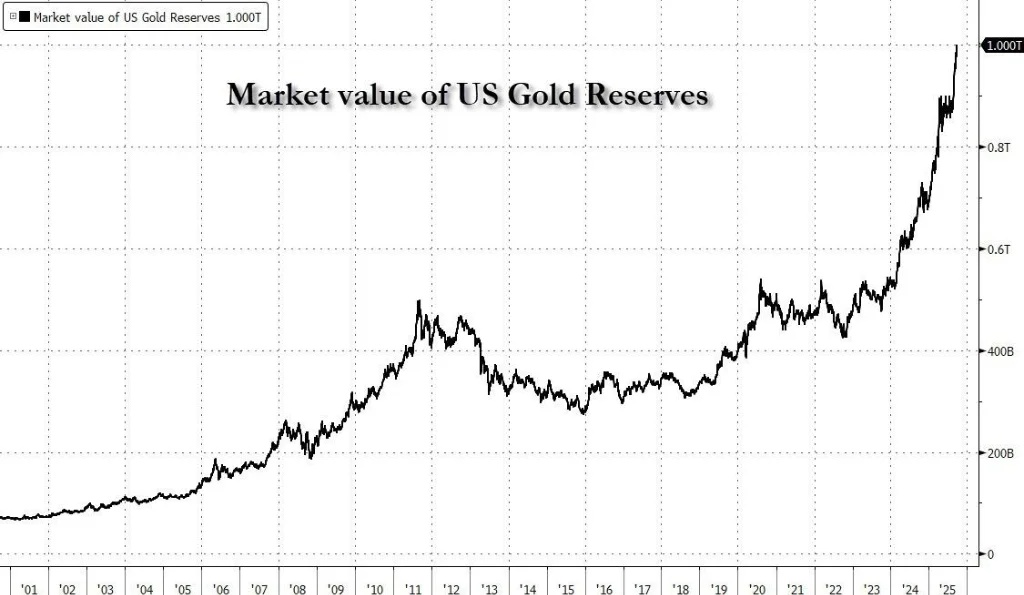
(Market value trend of U.S. gold reserves)
Unlike most countries, which deposit gold reserves in central banks, gold in the United States is directly held by the Treasury Department. The Federal Reserve holds gold certificates corresponding to the value of the Treasury's gold reserves, and uses them to provide the government with dollar credit.
This means that if the Ministry of Finance updates the value of its gold reserves according to the current market price, it will be able to inject about $990 billion into its coffers, thus significantly reducing the need to issue new Treasury Bond this year.
Market participants believe that although this move has legal doubts and may be regarded as unorthodox, considering the radical style of the Trump administration, the probability of gold revaluation is rising.
Revaluating gold reserves will directly affect the balance sheets of the U.S. Treasury Department and the Federal Reserve. Specifically, the assets of the U.S. Treasury Department will increase due to the revaluation of gold value, while its liabilities will rise simultaneously due to the issuance of equal gold certificates to the Federal Reserve.
At the same time, the Fed's balance sheet will expand accordingly. Its asset side will be added with equivalent gold certificates, while its liability side will be balanced by increasing deposits in the Treasury Cash Account (TGA).
The end effect is that the size of the Fed's balance sheet will be enlarged as a result, and it looks like a quantitative easing, but the whole process does not require any open market purchases.
In short,Simply agreeing to recognize the value of gold at fair value, the Ministry of Finance can create about $990 billion out of thin air for priorities such as debt repayment, deficit filling or setting up sovereign wealth funds.
In the market, revaluing gold reserves will be regarded as an unconventional policy tool.
The United States has not revalued its gold reserves for decades, mainly to guard against violent fluctuations in the balance sheets of the Treasury Department and the Federal Reserve, and to maintain the independence of fiscal and monetary authorities.
According to reports, this move is not without precedent. Countries such as Germany, Italy and South Africa have made decisions to reassess their gold reserves in recent decades.
For this unconventional operation, market analysts pointed out the potential risks.
Mark Cabana, a Bank of America strategist and former New York Fed official, believes that revaluing gold reserves to enrich cash accounts may stimulate macroeconomic activity, trigger inflation risks, and inject excess liquidity into the banking system.
He stressed that this move will relax fiscal and monetary policies at the same time, and the market may not take a positive attitude towards this, because it is equivalent to a disguised quantitative easing and may erode the independence of fiscal and monetary authorities.
In addition, the official revaluation of gold in the United States itself may further push up the prices of gold, Bitcoin and other assets that may be subsequently "remonetized".
Unless Treasury Secretary Bescent provides more credible details on how to "monetize the asset side of the U.S. balance sheet," the probability of its implementation remains low and legally problematic.
However, considering the Trump administration's "quick-moving and unconventional" style, some analysts believe that the possibility of gold revaluation is rising sharply. They believe that this expectation is one of the important drivers of the recent gold price approaching $4,000.
For investors who are bullish on gold, they can use option strategies to go long on gold.
Options Strategy: Using Put Options to Go Long Gold
In the face of the strong trend of gold, we can use the option strategy to make efficient long trading. The current gold price is 352.46dollar, we can sellExpires October 31, 2025, exercise price $325, premium $660Put Option to go long gold.
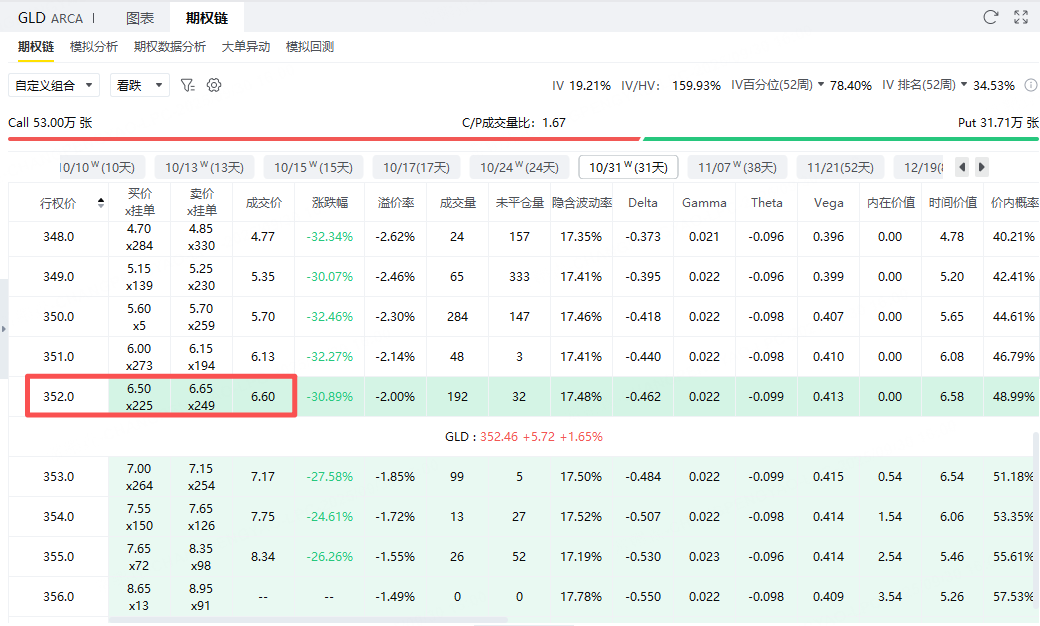
This strategy can not only make profits when gold rises, but even if gold prices move sideways or fall slightly, you can still rely on premium to earn gains.
Current price of underlying asset: $352.46
Option Type: Put Option (Put)
Strike price: $325
Due: October 31, 2025
Premium: $660 (100 oz per contract, or $6.60 per ounce)
Maximum Earnings: premium Revenue
The maximum profit of the seller is the premium received of US $660. As long as the underlying price at expiration is ≥ US $325, the option will be invalid, and the seller will keep all the premium income.
Breakeven point: Strike price − premium per ounce = 325 − 6.60 = $318.40
The overall profit is only when the underlying price is above $318.40 at expiration; Breakeven at $318.40; Below this price, there will be a loss.
sum upAgainst the backdrop of global monetary easing and intensified geopolitical risks, gold has shown strong safe-haven demand. Using the options market, investors can establish long positions in gold at a lower cost by selling put options strategies. This can not only make a profit in the rising market, but even if the gold price trades sideways or falls slightly, it can also make a profit by virtue of the premium. It is a stable investment choice that conforms to the market trend.
Disclaimer: Investing carries risk. This is not financial advice. The above content should not be regarded as an offer, recommendation, or solicitation on acquiring or disposing of any financial products, any associated discussions, comments, or posts by author or other users should not be considered as such either. It is solely for general information purpose only, which does not consider your own investment objectives, financial situations or needs. TTM assumes no responsibility or warranty for the accuracy and completeness of the information, investors should do their own research and may seek professional advice before investing.
