


AI Agent Revolution: Anthropic's 30-Hour Marathon vs. OpenAI's Lifestyle Takeover!
On September 30, the $Invesco QQQ(QQQ)$ index closed slightly higher at 0.46%, yet the underlying driving forces were exceptionally robust: Anthropic unveiled its Claude Sonnet 4.5 model, while OpenAI pursued a two-pronged strategy: partnering with Stripe to integrate shopping features into ChatGPT and preparing to launch Sora 2, a video-generating social app.
Anthropic's Claude Sonnet 4.5: From "7 Hours of Autonomy" to "30-Hour Marathon," the Era of AI Agents Officially Begins
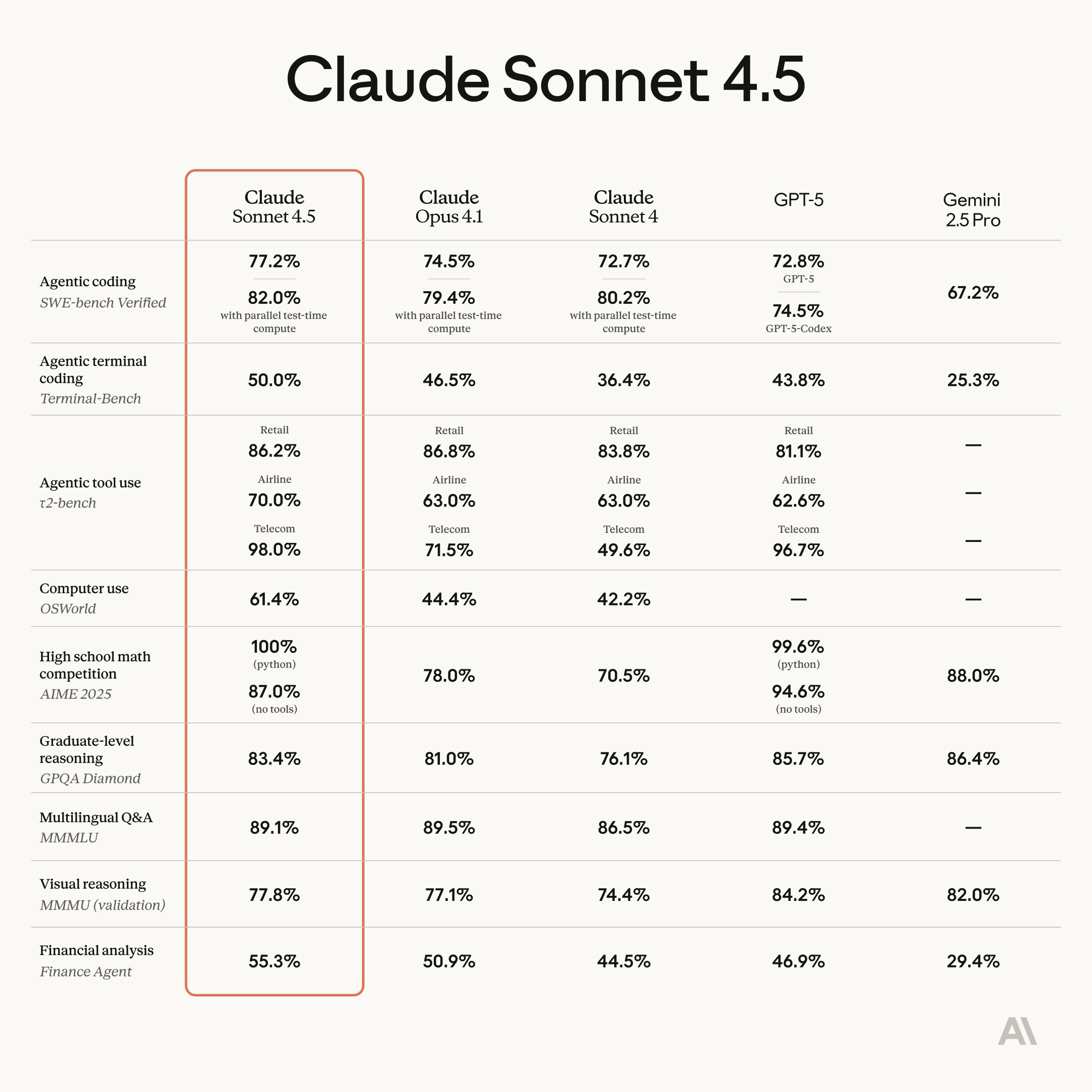
First, let's discuss Anthropic's groundbreaking update. The Claude Sonnet 4.5 model officially launched today, with its core selling point being a leap in autonomous operation capability—jumping directly from the 7-hour limit of the previous Opus 4 model to 30 hours of continuous, uninterrupted operation. This represents a strategic breakthrough in AI agent and coding domains. Recall that when Opus 4 launched in May, its "7-hour autonomy" caused quite a stir. Now, Sonnet 4.5 is proudly touted by the company as "the world's best practical agent, coding, and computer interaction model," particularly leading the market in its "computer usage" capabilities (a feature that first emerged nearly a year ago).
Anthropic is tackling the core challenge in AI applications—shifting from passive response to proactive execution. In cybersecurity, financial services, or scientific research, this model handles complex, long-context tasks rather than shallow conversations. Feedback from testing partner Canva stands out, demonstrating how it streamlines the entire workflow from codebase engineering to product feature development. This dramatically boosts efficiency, transforming AI from a "chatbot" into a "digital workforce." Amid accelerated iterations of multimodal AI models (combining text, images, and video), Sonnet 4.5's coding expertise will further widen the gap between Anthropic and competitors like OpenAI and Google. While the latter two lead in general-purpose models, their agent-based deep applications remain relatively immature.
$Amazon.com(AMZN)$ shares edged up 1% as investors bet that training and inference demands for Sonnet 4.5 will boost AWS utilization. As a deeply integrated AWS partner, Anthropic's model upgrade essentially constitutes an "implicit endorsement" of cloud computing. Jensen Huang's optimistic remarks on the BG2 podcast—describing demand as "unprecedented"—further corroborate that the AI agent wave will amplify GPU scarcity.
In the short term, AMZN's cloud business is valued at 23 times its 2026 projected EPS (with a target price of approximately $250). However, if Anthropic's market share climbs from its current 5% to 10%, 2027 EPS could reach $13—allowing bulls to comfortably roll over their positions into next year.
Of course, if OpenAI's counterattack—such as GPT-5—launches first, Anthropic's "best agent" reputation may fade.
OpenAI Accelerates Commercialization as ChatGPT Transforms into a "Shopping Assistant"; Sora App May Ignite New Video AI Battlefield
While Anthropic focuses on "productivity tools," OpenAI resembles an ambitious "lifestyle architect." Among its two major moves, the first is its partnership with Stripe: U.S. ChatGPT users can now complete purchases on Etsy and Shopify directly within conversations. This marks a shift in online retail from a linear "search-browse-checkout" process toward a conversational, frictionless experience.
TechCrunch's analysis cuts to the chase: OpenAI is eroding the gatekeeper status of $Alphabet(GOOGL)$ and Amazon (AMZN), which have long monopolized product discovery, recommendation, and payment processes.
At its core, this represents a redistribution of power in e-commerce. Traditional players rely on algorithmic rankings, while ChatGPT leverages its high conversion rates (SimilarWeb data shows its shopping intent capture efficiency far surpasses search engines) to deliver personalized recommendations, comparisons, and one-click payments.
Yesterday's market action saw $Etsy(ETSY)$ surge 15%, $Shopify(SHOP)$ climb 6%, Google (GOOG) dipped slightly by 1%. For ETSY, while instant checkout items aren't prioritized in rankings, this undoubtedly serves as a narrative catalyst—combined with recent improvements in third-party data, short sellers have begun covering their positions. Long-term, if OpenAI expands to more platforms, it could reshape the commission ecosystem: AI chatbots may evolve from "free tools" into "paid intermediaries."
Following closely is the development of the Sora 2 social app. Wired exclusively reveals that OpenAI will launch a standalone app designed specifically for its next-generation video generation model, Sora 2. Its interface closely resembles TikTok—featuring vertical video feeds, swipe-based browsing, and a "For You" algorithm. The main menu supports likes, comments, and mashups. The key difference: all content is AI-generated. Users can only create short clips up to 10 seconds long using Sora 2, with no option to upload personal media. This isn't merely an "AI TikTok"—it's a revolution in content creation, shifting from user-generated content (UGC) to AI-generated content (AIGC). This shift could potentially trigger a surge in demand for GPUs and hard disk drives (HDDs).
E-commerce stocks enjoy a short-term rally, while hardware supply chains prepare for takeoff.
For ETSY and SHOP, this represents an exceptional catalyst driven by both narrative and data. Should ETSY's GTV (Gross Transaction Value) rebound as a result, its 2026 EPS could easily exceed street expectations. As the platform's central hub, SHOP stands to benefit even more from its multi-merchant ecosystem. Google's 1% decline represents a soft landing—amid its AI transformation, its search business demonstrated greater resilience than anticipated (similar news previously triggered a 5% correction).
The hardware spillover effect from the Sora App is equally compelling: Seagate (STX) rose 5%, Western Digital (WDC) surged 9%, and Morgan Stanley highlighted that HDD visibility has reached an "unprecedented" 18-month level. Elevating hard drives from "cyclical commodities" to "AI oligarch assets" aligns perfectly with the explosive growth of multimodal models like video AI. $Seagate Technology PLC(STX)$\ $Western Digital(WDC)$ , AI memory remains one of the hottest sectors today, $SanDisk Corp.(SNDK)$ has already hit new highs.
Anthropic's Claude upgrade has expanded the practical boundaries of AI agents, while OpenAI's dual-track approach to e-commerce and social media has broadened its consumer reach. Together, these two major moves signal an accelerated shift in AI's penetration from "backend computing" to "frontend life."
Disclaimer: Investing carries risk. This is not financial advice. The above content should not be regarded as an offer, recommendation, or solicitation on acquiring or disposing of any financial products, any associated discussions, comments, or posts by author or other users should not be considered as such either. It is solely for general information purpose only, which does not consider your own investment objectives, financial situations or needs. TTM assumes no responsibility or warranty for the accuracy and completeness of the information, investors should do their own research and may seek professional advice before investing.
- happiness000·2025-09-30Big moves aheadLikeReport