


🤔Bubble Carnival or "Baby Bubble"? Indexes & MAG7 Valuation Amid the AI Boom
[Heart]Hello Tigers,
Is the US market curently a Carnival Before the Bubble Bursts or a "Baby Bubble"?[Allin]
On September 25, the three major U.S. stock indices closed lower for the third consecutive day: the $Dow Jones(.DJI)$ fell 0.38%, erasing all gains since the Federal Reserve signaled a "50bp rate cut" on September 18; the $S&P 500(.SPX)$ dropped another 0.5%, with a cumulative 1.8% decline over three days; and the $NASDAQ 100(NDX)$ also fell 0.5%, showing obvious short-term pressure.
Latest Valuation Check-Up: Big-3 Indexes & Mag-7 at a Glance:
Ticker | Latest Price($) | YTD 2025 | TTW P/E | Forward P/E | Average P/E in 10 yrs | Forward P/E VS. Average P/E in 10 yrs |
6656.92 | 12.29% | 29.33 | 25.17 | 19.2 | 31.09% | |
24580.17 | 16.11% | 37.8 | 30.8 | 25.9 | 18.92% | |
46292.78 | 8% | 31.87 | 23.11 | 18.5 | 25% | |
178.43 | 32.32% | 39.39 | 31.46 | 40.95 | -23.17% | |
254.43 | 2.58% | 34.23 | 32.35 | 22.62 | 43.02% | |
509.23 | 20.29% | 32.91 | 32.68 | 28.16 | 16.05% | |
251.66 | 29.47% | 24.85 | 24.21 | 25.24 | -4.08% | |
252.34 | 29.84% | 24.84 | 24.28 | 25.16 | -3.50% | |
220.71 | -0.57% | 32.94 | 25.62 | 70.75 | -63.79% | |
755.4 | 27.91% | 26.97 | 21.43 | 26.14 | -18.02% | |
425.85 | 4.84% | 265.28 | 210.5 | 35.26 | 496.99% |
Read more on >>🤔Market is Expensive? A Glance of MAG 7 ’s P/E Ratio in 5 yrs
I. Three Core Triggers for the Three-Day Losing Streak
Powell’s "Bubble Pricking": On September 23, he explicitly stated that "stock market valuations are quite high," which was seen as an oral cooling signal from the Fed. Historical data shows that after a Fed Chair names excessive asset prices, the broader market typically corrects by 5%-7% on average within three months.
"Too Good" Economic Data Turns Negative: The preliminary September Markit Manufacturing PMI hit 54.2 (an 18-month high) and weekly initial jobless claims were below expectations. This pushed the probability of a 25bp rate cut in November down sharply from 74% to 49%, with the "Magnificent Seven" tech stocks falling 1.6% on average.
Trump’s "Government Shutdown Threat": He called for a federal government shutdown if spending cuts are not approved by October 1. During the 35-day 2018-2019 shutdown, the $S&P 500(.SPX)$ fell 12%, and now sectors like defense and infrastructure are pricing in this political risk early.
II. Valuation Debate: A Repeat of 1929 or a "Baby Bubble"?
Despite short-term corrections, U.S. stocks have still posted solid year-to-date gains:
$S&P 500(.SPX)$ up ~12.29%, $NASDAQ(.IXIC)$ up ~15.92%, and $Dow Jones(.DJI)$ up ~12.58%.
However, views on valuations are sharply divided:
(1) Bears: Warn of a "1929-style Crash"
Mark Spitznagel, founder of black swan fund Universa Investments, warned that the S&P 500 may rise 20% to 8,000 points in the short term but could then plummet 80%. His logic includes: lingering liquidity boosting risk appetite, current "carnival" mirroring pre-1929 crash patterns, and record-high stock allocations by households and institutions.
Short-term liquidity remains abundant: The Fed’s rate cut cycle has not ended, which continues to boost short-term risk appetite. The $S&P 500(.SPX)$ has risen by more than 13% so far this year, and a further 20% increase is "realistically possible";
Historical signals have emerged: Before the 1929 crash, the average annualized return in the 12 months before the bear market started reached 26%, and the index even doubled before peaking. The current market's "doomsday carnival" highly aligns with this characteristic;
Valuations and positions are approaching extreme levels: Long-term low interest rates combined with fiscal bailouts have pushed market valuations to historical highs. The proportion of U.S. household stock allocations has exceeded the peak during the dot-com bubble, and institutional stock exposures have even hit a new high since November 2007.
Metric | Dec 1999 | Sep 2025 | Take-away |
S&P 500 P/E (TTM) | 29.8× | 29.3× | Slightly lower, still top-5% historic |
Shiller CAPE | 44.2× | 37.1× | 84% of 1999 level, above 1929 |
Price/Sales | 2.1× | 2.9× | More expensive than 1999 |
Tech weight in S&P | 29% | 34% | Higher concentration |
Household equity/Fin assets | 22.50% | 20.70% | Knocking on 1999’s door |
New issues + SPACs/Mkt cap | 0.80% | 1.10% | Even more liquidity splash |
(2) Bulls: It’s a "Baby Bubble"
@Tiger_James Ooi strategist at Tiger Brokers, argues that the $NASDAQ 100(NDX)$ has risen only 120% since the 2023 AI boom—far less than the 1,073% surge during the 1995-2000 dot-com bubble.
Valuations also support this: the $NASDAQ 100(NDX)$ ’s current P/E is 30.7x (vs. its 10-year high of 40x), and the $S&P 500(.SPX)$ ’s P/E is still below its 10-year peak.
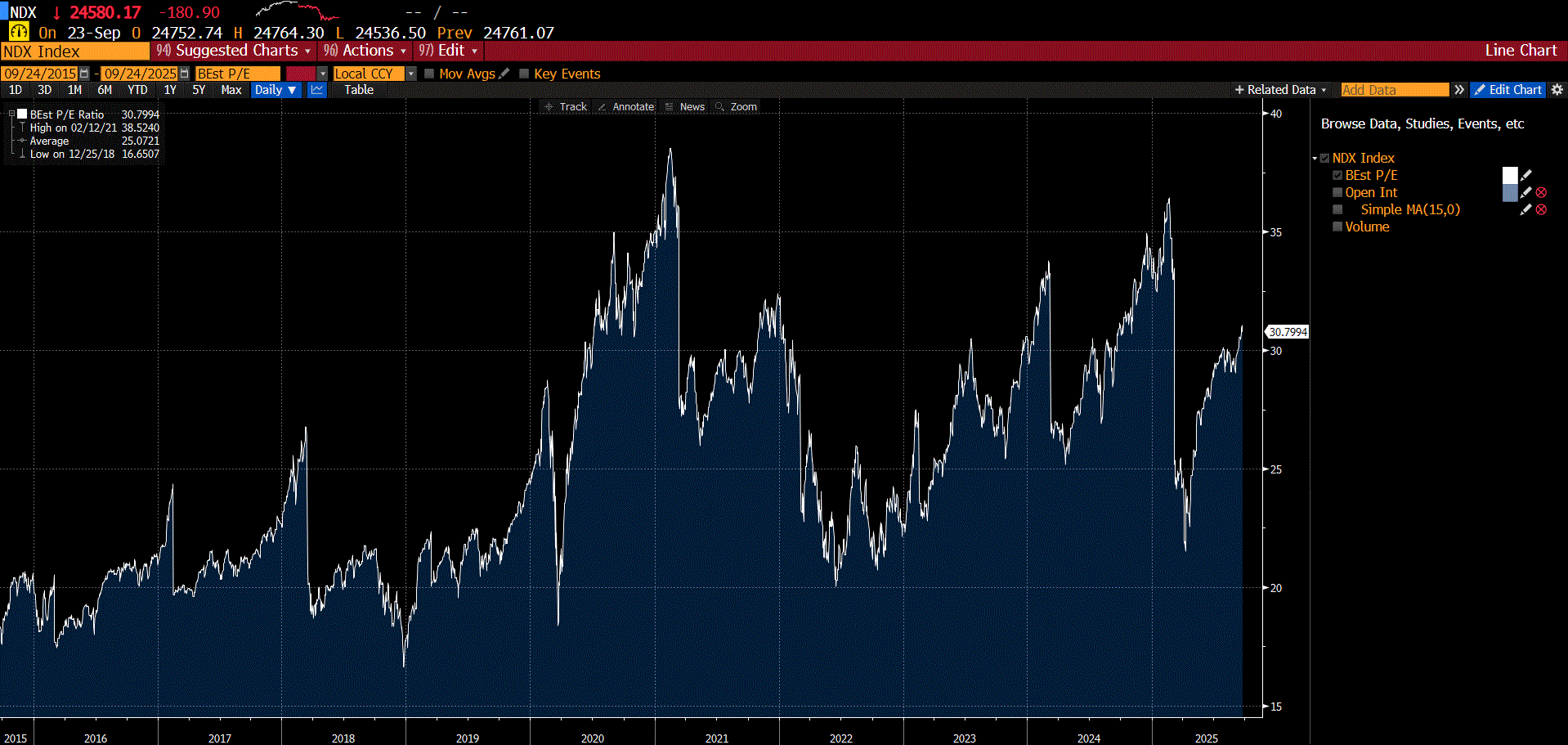
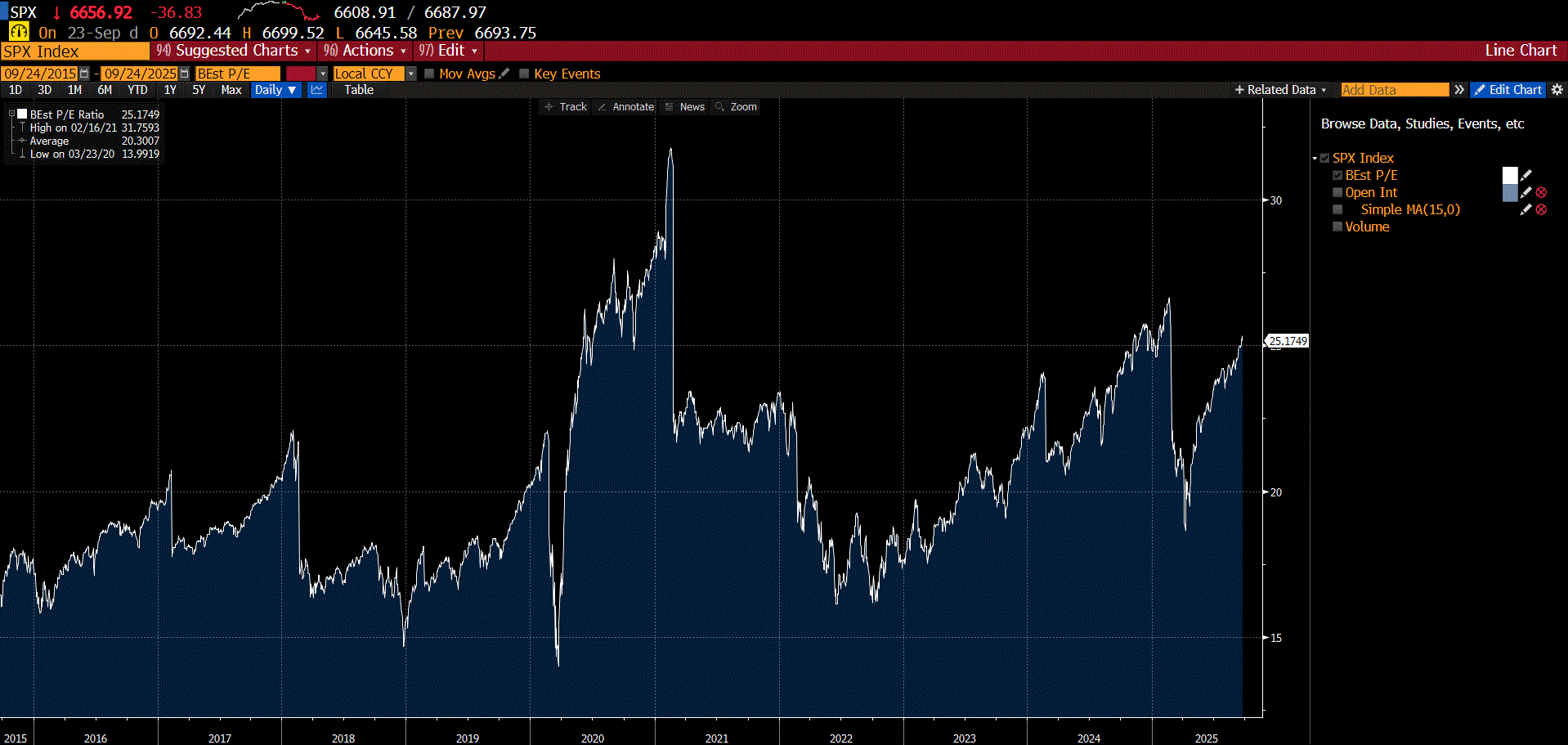
$Bank of America(BAC)$ ’s Michael Hartnett agrees the bubble isn’t finished: studying 10 major equity manias since 1900, the average trough-to-peak gain is 244%, implying the Mag-7 still has room to run. Boom phases are narrow and explosive—tech rallied 61% in six months during 2000 while the rest of the $S&P 500(.SPX)$ fell; today’s market has yet to reach that “extreme split.”
Hartnett advises hedging with “distressed value” stocks, as prior bursts of mega-cap euphoria ultimately lifted the economy and sparked a catch-up rally in cheaper names.
III. Four Risks of a Bubble Burst (with Probabilities)
Risk Type | Probability | Core Trigger Conditions | Impact on S&P 500 |
|---|---|---|---|
"Rate Hike-induced" Burst | 30% | Core PCE exceeds 3.5% in Q1 2026, forcing the Fed to shift to rate hikes | 35%-50% valuation pullback |
"Earnings Collapse" Burst | 35% | AI capex fails to drive revenue, dragging 2026 earnings growth to 0% (per Barclays: a 20% drop in data center capex could cut earnings by 3-4% and valuations by 10-13%) | 70% of stocks face a "Davis Double Whammy" |
"Liquidity Withdrawal" Burst | 20% | $1.2T in new U.S. Treasuries issued in Q4 2025 + ongoing QT, pushing 10-year Treasury yield above 5% | Triggered stock-bond rebalancing sell-offs |
"Black Swan" Burst | 15% | Escalated Middle East conflicts, cross-strait tensions, etc. | Over 20% flash crash within a week |
IV. Investor Responses: "Three Parachutes"
Institutional-style "Rebalancing": Trim 2% of holdings whenever the portfolio rises 5% to reset to target stock weights.
Option Hedging: Use Sell Put or Buy Put strategies to limit downside risk while holding long positions or call options.
Cross-asset Diversification: Allocate 20% of positions to short-duration high-yield bonds, gold, and undervalued non-U.S. markets (e.g., Japanese stocks, Hong Kong stocks, Latin American markets).
Risk Disclosure: This analysis is based on public market data and historical patterns, and does not constitute investment advice. Investors should make decisions based on their own risk tolerance.
🏦For SG users only, open a CBA today and enjoy privileges of up to SGD 20,000 in trading limit with 0 commission. Trade SG, HK, US stocks as well as ETFs unlimitedly!
Find out more here:
Disclaimer: Investing carries risk. This is not financial advice. The above content should not be regarded as an offer, recommendation, or solicitation on acquiring or disposing of any financial products, any associated discussions, comments, or posts by author or other users should not be considered as such either. It is solely for general information purpose only, which does not consider your own investment objectives, financial situations or needs. TTM assumes no responsibility or warranty for the accuracy and completeness of the information, investors should do their own research and may seek professional advice before investing.
"Currently, only about 20% of IT workloads are estimated to be hosted in the cloud, a percentage that is expected to steadily increase and eventually invert over time."
Great article