


How Will Alibaba's In-Store Expansion Impact Its Valuation?
$Alibaba(BABA)$ 's 26th anniversary should have been a time for fanfare and celebration, but this time, the setup they put together was quite interesting. It wasn't about cloud computing or Taobao Flash Sales. Instead, the long-absent "Koubei" was brought back to the stage once again, only this time, the spotlight shifted to AutoNavi.
That's right, you heard correctly. Alibaba has tasked AutoNavi with taking over in-store business operations and launched the so-called "AutoNavi Street Sweeping Ranking." Don't underestimate this move—it's a crucial step in Alibaba's strategy to reshuffle the local services landscape.
Many might wonder: Isn't AutoNavi just a map app? How does it connect to "in-store" services? That's precisely the genius of it. Maps offer a natural traffic gateway, especially in high-frequency travel scenarios, enabling seamless integration with dining, entertainment, and leisure activities. Alibaba has been trailing Meituan in the local services sector, while Ele.me was forced into a price war that led to massive losses and left behind a host of lingering issues. By reintegrating Koubei into Gaode Maps, Alibaba aims to leverage the combined power of "maps + scenarios + Koubei rankings" to counter Meituan's competitive advantage.
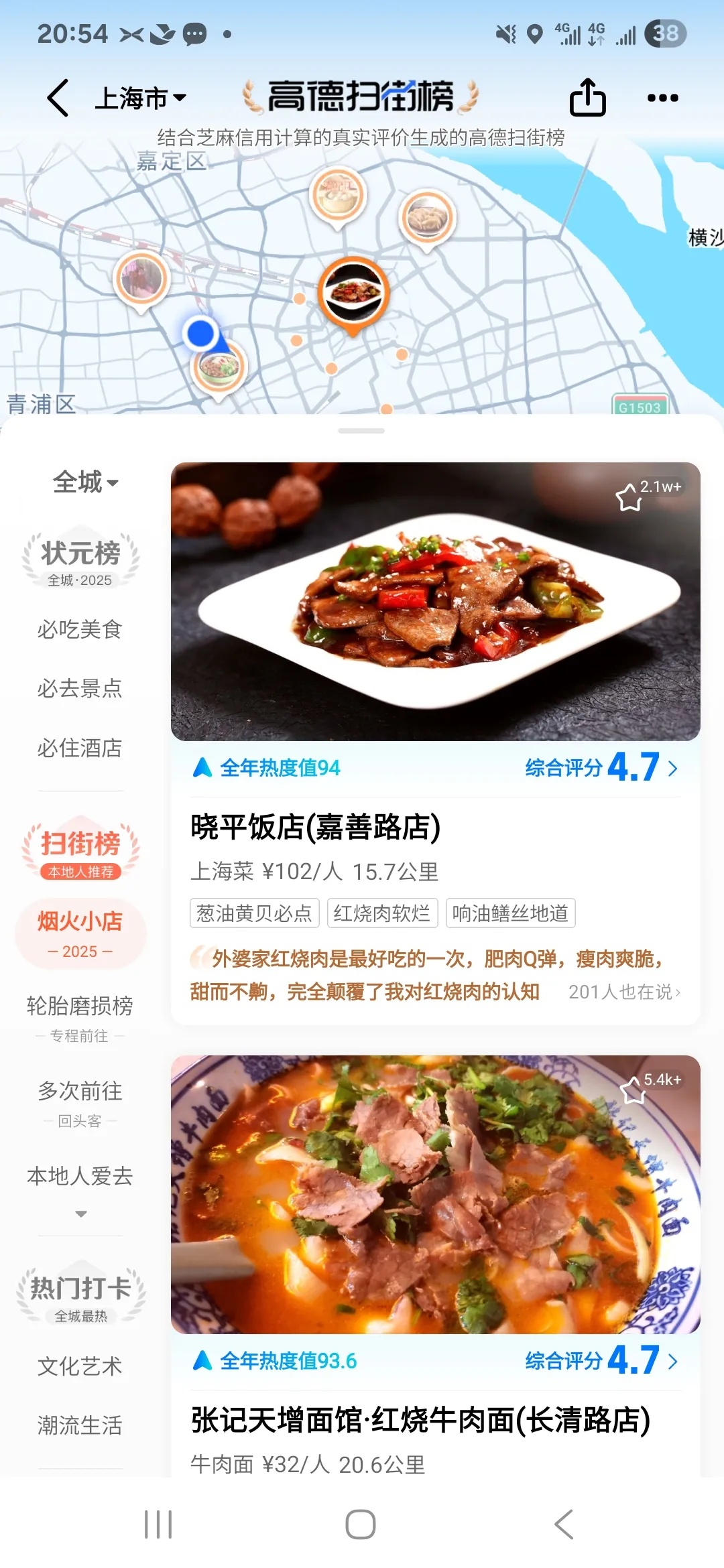
Alibaba's Logic: Handing Off In-Store Foot Traffic to AutoNavi
First, let's examine Alibaba's logic.
"Koubei" was originally incubated by Alipay, but its early strategy was overly e-commerce-centric—relying on group buying, red packets, and subsidies—ultimately turning it into a "second-tier Taobao" that failed to truly cultivate a vibrant merchant ecosystem. Later, it merged with Ele.me to form Alibaba Local Life. Yet over the years, Alibaba has consistently failed to outperform Meituan in this sector, with both traffic and user mindshare remaining suppressed.
This move to have Gaode take over is essentially an attempt to switch tracks.
Scenario Advantage: When you open Meituan, it's all about eating, drinking, and entertainment, while opening AutoNavi immediately shows "Where am I now? Where do I want to go?" This precision in real-time scenarios far surpasses simple information feed recommendations.
User Mindset: Users habitually search for restaurants, attractions, and businesses on maps—this constitutes natural "in-store traffic." Previously, "Koubei" existed within Alipay but lacked strong integration with payment scenarios.
Ranking Mechanism: Alibaba's "Street Food Rankings" shares similarities with Meituan's "Must-Eat List," but adopts a more casual approach. When combined with user-generated content (UGC) reviews and expert recommendations, these rankings readily generate viral content.
In other words, Alibaba isn't directly challenging Meituan's food delivery business this time. Instead, it's taking a new approach by leveraging its "map entry point + rankings and reputation" as a breakthrough, focusing its efforts on in-store services.
Why emphasize in-store visits? Because in-store visits yield higher gross profit margins.
Meituan's financial reports repeatedly emphasize that the gross profit margin for its local on-site services (including hospitality, leisure and entertainment, and beauty services) is significantly higher than that of food delivery. In 2024, Meituan's on-site hospitality and travel segment maintained a gross profit margin consistently above 70%, serving as the core profit driver for the entire group. Alibaba itself recognizes that relying solely on Ele.me's food delivery to wage price wars and burn cash for market share will only lead to greater losses. Therefore, shifting focus to the high-margin on-site segment represents a more rational strategy.
Significance for Alibaba's Overall Strategy
Many investors are asking: Why did Alibaba choose its 26th anniversary to bring this up?
The reason lies in Alibaba's current valuation structure, where e-commerce and cloud services form the two pillars. However, the market has consistently discounted the e-commerce segment. This is because e-commerce operates in a saturated market with limited growth potential. To achieve a higher valuation, Alibaba must create a "new narrative" in segments beyond e-commerce.
AI and cloud computing represent one direction, while local services represent another.
This relaunch of Koubei and its transfer to AutoNavi reflects Alibaba's attempt to tighten its ecosystem closed loop:
E-commerce Side: Selling goods on Taobao and Tmall generates consumer demand.
Payment Side: Alipay facilitates transactions, connecting users and merchants.
Local Life: AutoNavi is building up offline traffic for dining, entertainment, and leisure to complete the closed-loop ecosystem.
Traffic Synergy: Cross-platform user referrals between Taobao and AutoNavi, with payment systems further integrating membership programs.
This is a standard Alibaba playbook: reintegrating all entry points under its control to build a systematic capability to counter Meituan.
The Potential Impact of Alibaba on Meituan (Scenario Analysis)
What does $MEITUAN(MPNGF)$ fear most? Not subsidy wars, but having its entry points into consumer scenarios undermined.
In the past, Meituan's advantage lay in the fact that when users thought about dining, entertainment, or leisure activities, their first instinct was to open the Meituan app. However, if Gaode Maps can intercept users' initial clicks through its "map-based scenarios + ranking recommendations," it would pose a substantial threat to Meituan.
More crucially, Gaode has access to Alibaba's full suite of resources:
Taobao's traffic and merchant ecosystem can be integrated with AutoNavi for cross-promotion.
Alipay's payment and membership services can be extended to AutoNavi's in-store business.
Alibaba's advertising system enables merchants to deliver targeted campaigns.
This makes it difficult for Meituan to compete solely through traffic subsidies.
Meituan's Q2 earnings report has already shown signs of slowing growth, particularly in the on-demand services and travel segment, where growth has cooled significantly. If Alibaba's strategy with AutoNavi proves successful this time, it will directly undermine Meituan's profit pillar. It's important to note that while Meituan's food delivery business is substantial, its gross margin remains in the single digits. The real profit driver is its on-demand services segment. Should this core segment be eroded, the market's valuation framework for Meituan would be shaken.
I have created three scenario models, with all figures, sources, and assumptions clearly documented.
Core Local Commerce Quarterly Revenue (Q2) = RMB 6.5347 billion (Q2) → Annualized Base = 6.5347 × 4 = RMB 26.1388 billion. (Source: Meituan Q2 Financial Report)
Alibaba and Meituan have comparable market capitalizations (used to convert impact into market cap share): Alibaba market cap ≈ USD 349B Meituan market cap ≈ USD 78B
The current USD/CNY exchange rate is approximately 7.13 RMB/USD (used for RMB ↔ USD conversion).
Key Assumptions:
Market share. Gaode can capture a proportionate share of Meituan's "in-store/local" traffic (scenario assumption: 3%/5%/10% of annualized revenue share transferred from Meituan to Alibaba).
Profit Margin. If we assume an incremental operating margin (OM) of 15% (conservative) to 25% (aggressive) for Alibaba's new "in-store" revenue, the rationale is as follows: The in-store business has no delivery costs and relies on long-term, reliable monetization through commissions, marketing, membership fees, and services. Its gross margin should outperform delivery-based segments, though short-term investments (S&M, subsidies, technology) remain necessary. Meituan's current marginal operating margin (short-term margin after Q2 compression) is reported at 5.7% (Q2). For long-term comparison, we use 15%-20% (reflecting its "normal" margin if the competitive landscape stabilizes).
Calculations indicate that based on Alibaba's market cap (~USD 349B) and Meituan's market cap (~USD 78B): Even under a more aggressive scenario (Alibaba capturing 10% market share with strong monetization at a 25% margin), Alibaba's annualized incremental operating profit would be ~$917M. When discounted using common valuation multiples, this would only impact its market cap by a low to mid-single-digit percentage (rather than a disruptive shift in magnitude).
Valuation Impact
Of course, once the high-margin in-store business gains traction, it will significantly improve the profitability model of the local services segment. Unlike food delivery, Alibaba doesn't need to burn cash subsidizing riders. By focusing on traffic distribution and nurturing a robust merchant ecosystem, it can replicate Meituan's "high-margin logic." While short-term performance contributions won't be immediate, this approach holds long-term promise to unlock new profit pools.
We estimate that capturing 10% of Meituan's market share, with a 25% margin and a 20x valuation multiple, would likely boost Alibaba's market capitalization by approximately 3%. This represents a change in the single-digit percentage range (not an immediate valuation leap). Of course, considering the investment cost of just 1 billion yuan, the ROI for this portion is exceptionally high.
The current market valuation for Alibaba's e-commerce business is relatively low, largely driven by the growth narrative of Alibaba Cloud. If AutoNavi's in-store business proves successful, it would add a new high-margin growth driver for Alibaba, naturally raising its valuation ceiling. In other words, this effectively gives Alibaba a "second story" in the capital markets, offsetting concerns about the e-commerce sector's weakness.
Meituan's current valuation heavily relies on the "stable cash flow from its in-store business." Should the market begin to worry about erosion in this segment, valuations could be adjusted downward even before any short-term performance decline materializes. While Meituan was previously described as a "dual-engine model driven by food delivery and in-store services," if food delivery margins remain thin and Alibaba captures growth in the in-store segment, the market may reassess Meituan's valuation downward.
Personal opinion
Some may view Alibaba's "Street Sweeping Ranking" as a minor maneuver, but I believe it represents a strategic pivot in its local services strategy: moving away from head-on subsidy wars and instead leveraging its ecosystem advantages in mapping, payments, and e-commerce to capture user mindshare at its source.
This certainly poses a threat to Meituan. While Meituan previously feared Douyin's "Local Life" feature siphoning off users, now it faces competition from AutoNavi. Douyin relies on traffic and content, while AutoNavi leverages its mapping ecosystem. With these two forces converging, it remains uncertain whether they can dethrone Meituan's "Must-Eat List."
In the capital markets, Alibaba is crafting a new narrative beyond cloud and AI—one centered on "in-store + high-margin" services—to build a more comprehensive valuation logic. Meanwhile, Meituan's story faces scrutiny. While short-term performance may not falter, its long-term growth projections are likely to undergo reassessment.
In a nutshell: Alibaba has finally realized it can't just fight Meituan tooth and nail in the food delivery arena—it needs to chip away at Meituan's moat of in-store gross profit. This battle has only just begun.
Disclaimer: Investing carries risk. This is not financial advice. The above content should not be regarded as an offer, recommendation, or solicitation on acquiring or disposing of any financial products, any associated discussions, comments, or posts by author or other users should not be considered as such either. It is solely for general information purpose only, which does not consider your own investment objectives, financial situations or needs. TTM assumes no responsibility or warranty for the accuracy and completeness of the information, investors should do their own research and may seek professional advice before investing.
- EltonRichard·2025-09-11This strategy could really redefine Alibaba's market position.LikeReport