


Google Escapes Disaster: Chrome Saved, But Exclusive Deals Axed! Apple Is Winner?
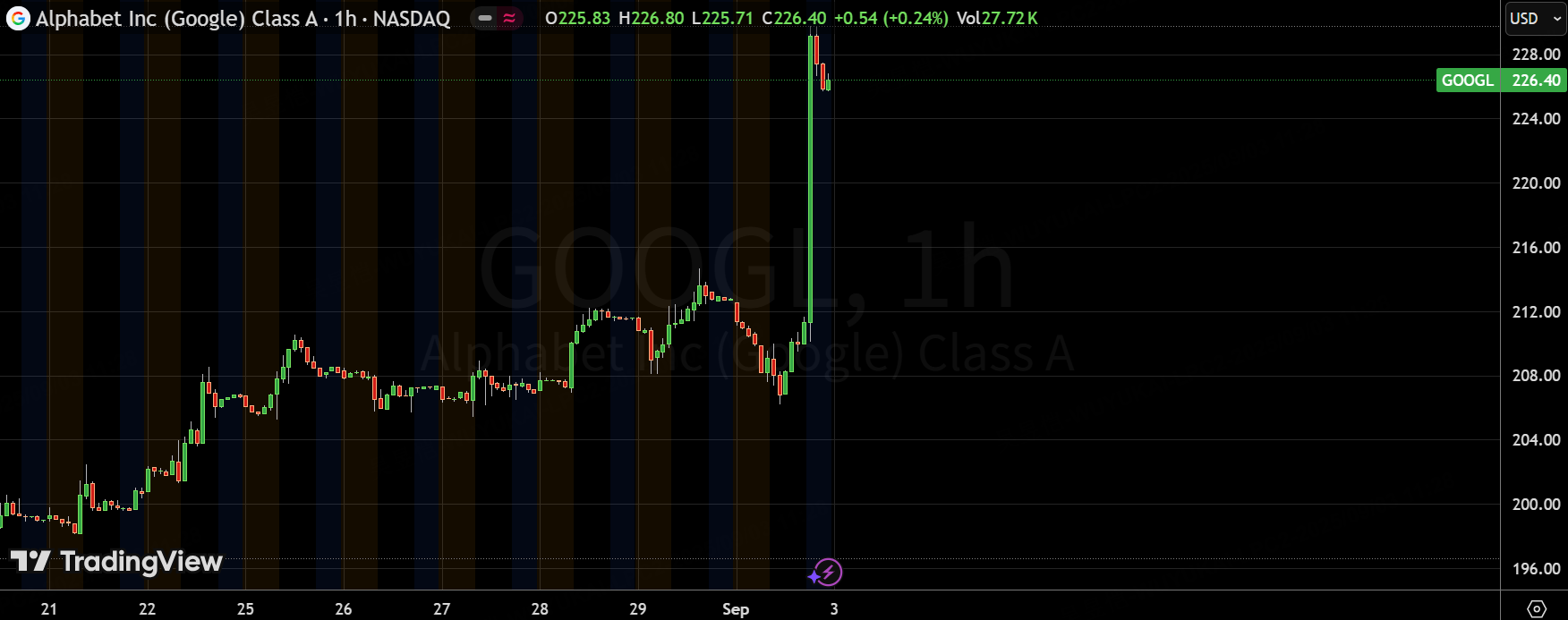
Judge Amit Mehta rejected the Department of Justice's request to force $Alphabet(GOOG)$ to divest Chrome, while prohibiting it from signing exclusive search agreements and mandating a degree of data sharing. The market reaction was straightforward: Google and Apple shares both rose, climbing nearly 6% and 3% respectively in after-hours trading—a classic case of "bad news is priced in." But zooming in reveals the ruling's vastly different implications for each company: $Alphabet(GOOGL)$ managed to "hold the line," while $Apple(AAPL)$ reaped "unearned gains."
In contrast, Apple emerged virtually unscathed and even gained a bargaining chip. Google pays Apple approximately $20 billion annually for the default search position in Safari—after the ruling, this payment remains intact, but the "exclusivity clause" has been removed. What does this mean? It means Apple can now invite Bing, or even new AI players, to bid for the position. To maintain its standing, Google will likely have to pay more. Apple's short-term service revenue is thus secured, and the stock price surge is justified. But the deeper shift lies in strategic flexibility: Apple is no longer locked into Google, enabling it to simultaneously advance its own Apple Intelligence and even enhance Siri and Safari's AI search experience through multiple suppliers. For Apple, this represents a double win—stable cash flow plus enhanced long-term freedom. Of course, the risk lies in potential instability of future TAC payments, which could cause revenue fluctuations. Yet in my view, this poses little concern for Apple—a company with substantial cash reserves and a valuation already under pressure. Long-term, this flexibility could even unlock an additional 10-15% upside potential for Apple's ecosystem control.
At the industry level, this ruling strikes a balance between regulation and market forces. Google hasn't been crippled, but must open up more competition; Apple retains its cash cow while gaining stronger bargaining power; and emerging AI search companies see an opening for regulatory dividends. In the short term, this "clearance event" has eased regulatory uncertainty, boosting market sentiment. Both stocks are now on a trajectory of "valuation reassessment." However, investors must not overlook future structural risks: for Google, the gradual erosion of its competitive moat; for Apple, the volatility of its services revenue.
This ruling is a partial victory for Google, yet a complete win for Apple.
Google has safeguarded its core assets, providing near-term momentum for its stock price, but long-term resilience will require leveraging AI and product strength to counter intensifying competition. Apple has not only preserved its cash flow but also gained greater leverage in future negotiations over search and AI ecosystems. For investors, the valuation logic for Google and Apple will gradually diverge over the next two years—Google must demonstrate its ability to maintain competitive advantages through execution, while Apple may experience a wave of "AI-driven service premium revaluation."
Disclaimer: Investing carries risk. This is not financial advice. The above content should not be regarded as an offer, recommendation, or solicitation on acquiring or disposing of any financial products, any associated discussions, comments, or posts by author or other users should not be considered as such either. It is solely for general information purpose only, which does not consider your own investment objectives, financial situations or needs. TTM assumes no responsibility or warranty for the accuracy and completeness of the information, investors should do their own research and may seek professional advice before investing.
- Himzzi175·2025-09-03google jumping by 6-7% due to this ruling, is ridiculous!1Report
- BelindaHaywood·2025-09-03Wow, what an insightful breakdown! [Great]1Report