


Hong Kong stock bull market peaks? How to play bear market spread
Since the beginning of this year, the Hong Kong stock market has experienced explosive growth in both initial public offerings (IPOs) and refinancing scale.
On July 6, Chen Maobo, Secretary of Finance of the Hong Kong SAR Government, said,In the first half of this year, the Hong Kong stock market completed a total of 42 IPOs, and the total amount of funds raised exceeded HK $107 billion, which is about 22% more than last year, temporarily ranking first in the world.The Hang Seng Index rose 20% cumulatively, exceeding 4,000 points, the largest first-half increase in points in history.
"The market is generally optimistic about the performance of Hong Kong stocks and the new stock market in the second half of the year, and the number of applications for IPOs in Hong Kong is increasing rapidly." Chen Maobo said that about 200 applications have been received so far, doubling the number from the beginning of the year, including those from the Middle East and Southeast Asia. companies.
According to industry insiders, this significant increase shows the recovery of market vitality and the increase of investor confidence. The amount of refinancing exceeded the full-year scale in the past three years, especially the placement method dominated, demonstrating the efficient allocation ability of the Hong Kong stock market.If this trend continues, it will help to further expand the depth and breadth of the Hong Kong stock market.
At present, the profit-making effect of A-share and Hong Kong stock markets has returned to attracting foreign investment attention. Citigroup recently released the latest strategy report for the Asia-Pacific stock market, upgrading the ratings of the Chinese and Korean stock markets to "overweight". Citi said that despite the volatile macro environment, Asian stocks still outperformed their global peers. Macroscopically, China is committed to shifting local economic growth towards consumption-led rather than investment-led. The boost measures expected to be launched by relevant departments include consumer vouchers, fiscal and monetary policies. The policy intensity may be moderate, and industries such as consumption, Internet, raw materials and technology may benefit more from the policy.
However, as the rising market further deepens, the market may also usher in drastic waves. Investors can also consider using option strategies such as bear market price spreads to short.
What is a bear market spread strategy?
A bear market spread is an option strategy in which option traders expect that the price of the underlying asset will fall in the future. Traders want to short the underlying asset and want to limit trading within a certain risk range.
Specifically, the bear market bullish spread is achieved by buying bullish options at a specific strike price, while selling the same number of bullish options with the same expiration date at a lower strike price.
Short YINN specific case
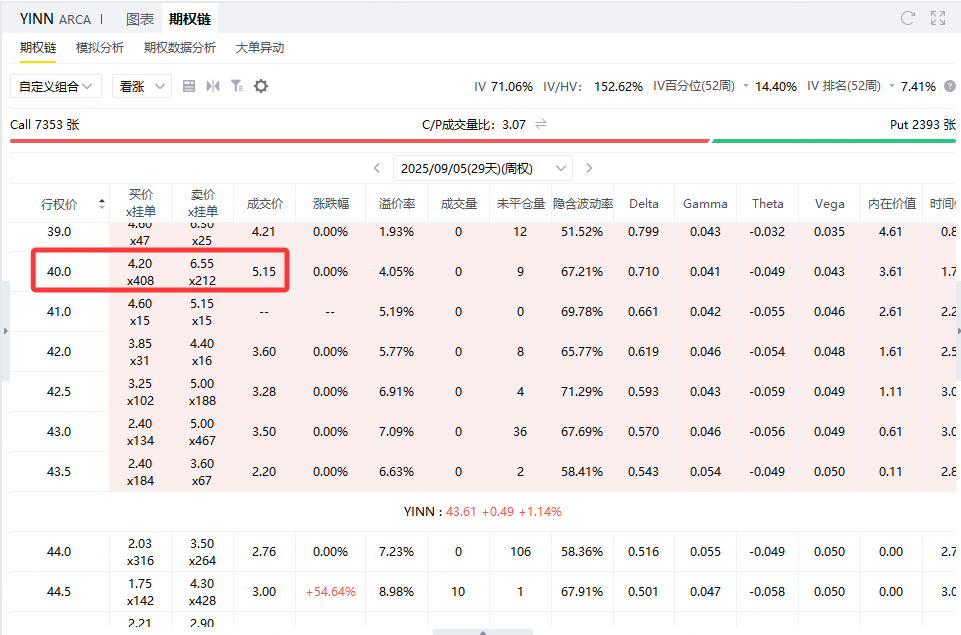
Take shorting YINN as an example,$Triple Long FTSE China ETF-Direxion (YINN) $The current price is $43.61. Assuming that investors expect it to fall to around $40 on September 5, investors can use the bear spread strategy to short YINN at this time.
Step 1: Sell the bullish option with an exercise price of 40 expiring on September 5 and get a premium of $515.
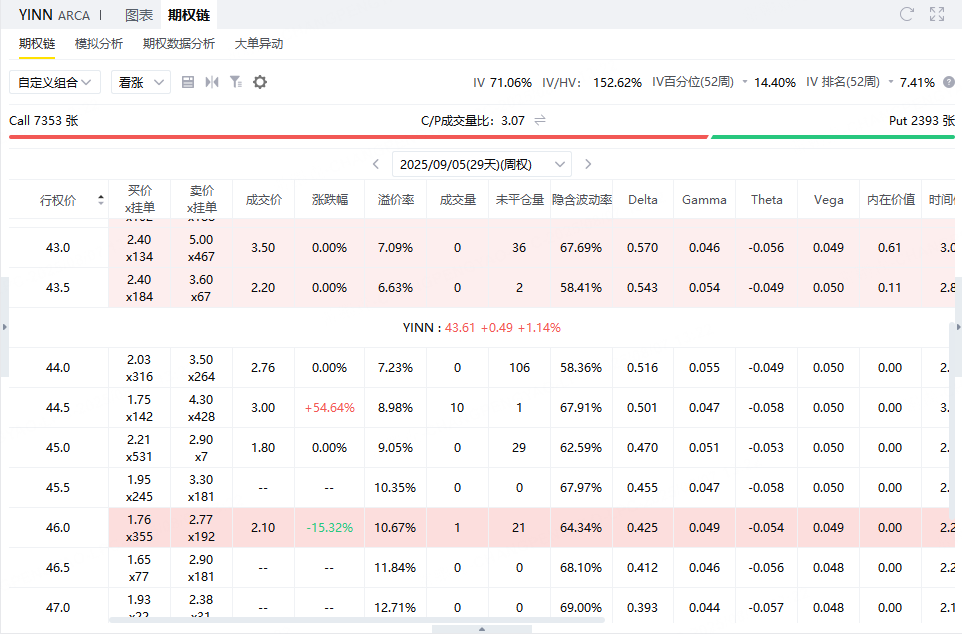
Step 2: Buy a bullish option with the same expiration date and an exercise price of 46, spend a premium of $210, and the bear market spread is established.
strategy: Bear Call Spread
Sell outSeptember 5thExercise price40Bullish option, collect$515Royalties
BuySeptember 5thExercise price46Bullish option, payment$210Royalties
Establishment costs (net royalty income):515-210 =$305
Maximum spread:46-40 =$6(Approximately 100 shares each, corresponding to$600)
Profit and loss calculation:
Maximum profit (YINN ≤ 40):
When the YINN price expires below or equal to $40 on September 5, both bullish options have no value and investors retain$305Net Benefits
Maximum profit = $305
Maximum loss (YINN ≥ 46):
When the YINN price is higher than $46, the spread between the two options reaches the maximum ($6), and investors need to pay$600, but received$305Final net loss:
Maximum loss = 600-305 = $295
Break-even point:
BEP = exercise price of options sold + net premium income ÷ 100
40 + (305/100) =$43.05
If the maturity YINN price is $43.05, investors will be flat
Strategy Summary
Higher winning rate: As long as the YINN price at expiry is lower than$43.05, that is, there is profit
Maximum profit$305,Maximum loss$295,The profit-loss ratio was approximately 1.03Risks are controllable
Applicable to holding YINNMild bearish or volatileExpected investors do not require a sharp drop, as long as the price does not rise above the profit-break point
Principal RisksAs YINN rose sharply toAbove $46, triggering maximum loss
Disclaimer: Investing carries risk. This is not financial advice. The above content should not be regarded as an offer, recommendation, or solicitation on acquiring or disposing of any financial products, any associated discussions, comments, or posts by author or other users should not be considered as such either. It is solely for general information purpose only, which does not consider your own investment objectives, financial situations or needs. TTM assumes no responsibility or warranty for the accuracy and completeness of the information, investors should do their own research and may seek professional advice before investing.
