


Bitcoin Breaks Through $123K, Time To Short?
Bitcoin, the world's largest cryptocurrency, crossed the $123,000 mark for the first time on Monday, driven by the Trump administration's friendly policies and big money allocations. BlackRock's Bitcoin Spot ETF is moving towards a $100 billion scale.
With stablecoin legislation on the verge of passage, U.S. House Republicans announced "Cryptocurrency Week". In the latest move to deregulate, U.S. officials on Monday released new guidance on how banks can provide custody services related to digital asset classes.
The squeeze on Bitcoin shorts wiped out billions of dollars in bearish bets, which in part helped Bitcoin rebound by about 15% over the past week.
This is in stark contrast to what was happening some time ago. For months, Bitcoin has remained within a narrow range of volatility, as investors deal with trade tensions and some former big buyers also sell off. But Bitcoin advocates are holding on, at the same time crypto exchange-traded funds (ETFs) are booming again, with financial firms led by Strategy committing to buy billions of dollars in Bitcoin.
Eric Jackson, president and founder of EMJ Capital, said: "We didn't expect this upward momentum to be so rapid. Many savvy investors I talk to believe that by the end of this year, the price of Bitcoin may soar quickly to $150,000, or even $250,000."
ETFs and institutions are still buying in large quantities, while a group of long-term holders and miners are simply reluctant to sell their Bitcoin.
Adam Guren, founder and chief investment officer of Hunting Hill Global Capital, said: "We are seeing record-low outflows from exchanges and tight orders. There are simply no sellers to digest demand. Bitcoin's breakthrough of $120,000 is not so much a'sprint 'as a'squeeze'."
The massive wave of liquidations accelerated the cryptocurrency's rally as bears bought it to close out their positions-about $574 million was liquidated in the past 24 hours.
More than $1 billion of short positions were liquidated on July 9 when Bitcoin first broke through its previous all-time high, one of the largest single-day liquidation events this year, according to data compiled by Coinglass.
Last week, U.S.-listed Bitcoin ETFs attracted more than $2.7 billion in inflows, the fifth-largest weekly inflow since launching in January 2024. BlackRock's iShares Bitcoin Trust (IBIT) now has a market cap of more than $85 billion. Bloomberg Intelligence predicts that the BlackRock ETF could soon reach $100 billion in assets.
Meanwhile, open interest in Bitcoin futures reached a record $86.3 billion, according to data compiled by Coinglass. Data compiled by CoinGecko shows that the combined market capitalization of all tokens is currently approaching the $4 trillion mark.
While investors are pouring into ETFs, a new wave of financial companies have also become new participants in this bull market.
From SoftBank Group's Twenty One Capital and Justin Sun's TRON Inc. to cryptocurrency entrepreneur Anthony Pompliano's ProCap Financial Inc., companies are buying cryptocurrencies through equity and convertible bonds. Meanwhile, Strategy remains a major corporate holder, holding more than 600,000 Bitcoin pieces on its books, worth a whopping $73 billion.
However, the market landscape is far from indestructible. The rally was helped by a more upbeat risk appetite sentiment on Wall Street overall, with stocks near all-time highs and AI stocks rallying sharply. An escalation in trade tensions could break that momentum, with prominent figures such as JPMorgan Chase's Jamie Dimon warning that Wall Street underestimated the possibility that US President Donald Trump could reintroduce protectionist policies.
For investors with a bearish view, you can consider the bear market call spread.
What is a Bear Call Spread Strategy?
A bear call spread is an options strategy in which options traders expect the price of the underlying asset to fall for some time to come, the trader wants to short the underlying and wants to limit trading to a certain risk range.
Specifically, the bear market call spread is achieved by buying a call option at a specific strike price while selling the same number of call options with the same expiration date at a lower strike price.
Specific cases of shorting MSTR
Take shorting MSTR as an example,$Strategy (MSTR) $The current price is $440. Assuming that investors expect a drop to around 300 on September 19, investors can use the bear market spread strategy to short MSTR at this time.
Step 1: Sell the call option with an exercise price of 300 expiring on September 19 and get a premium of $15,560.
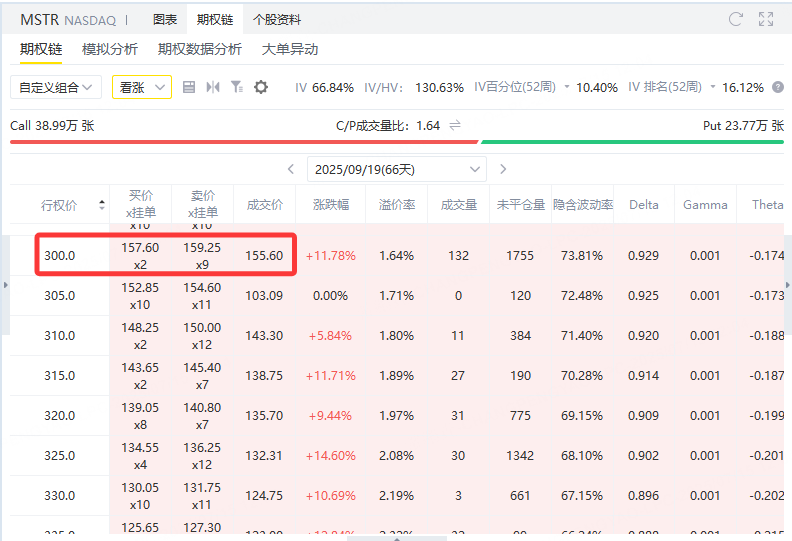
Step 2: Buy a call option with the same expiration date and an exercise price of 480, which costs $3,339 premium, and the bear market spread is established.
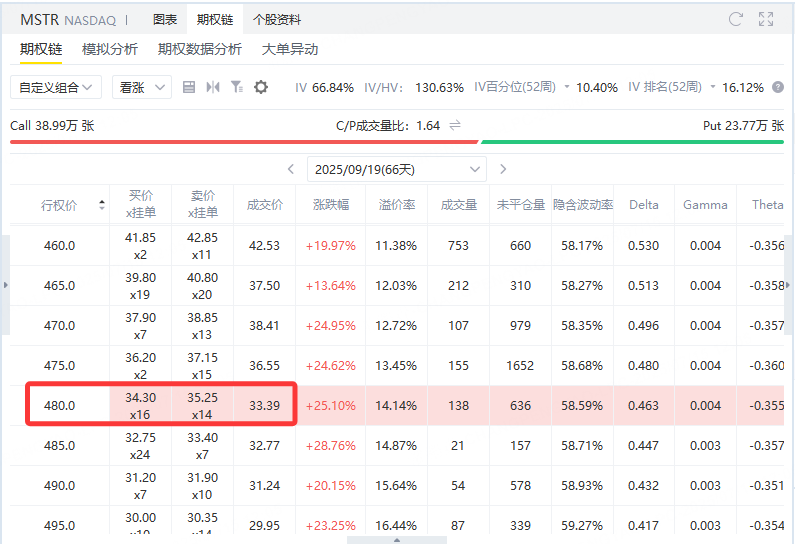
Premium vs. initial net income
Revenue: Sold call option to get $15,560
Payouts: Cost $3,339 to buy the call
The net income is 15,560-3,339 = 12,221 US dollars. If the stock price of this part of premium is lower than 300 US dollars at maturity, it will become the final profit.
Profit and loss after maturity
When MSTR Stock Is Below $300Neither call option will be executed at this time, and the strategy holder will receive the full net income. The maximum gain was $12,221.
MSTR stock in the $300-$480 rangeAt this point, the 300 strike call option sold will be exercised, resulting in a loss, while the 480 strike option bought is still out of the money. The net profit and loss of the strategy is: stock price-300, minus premium revenue of $12,221.
When MSTR Stock Above $480Both options will be exercised at this point, with a spread of $180, or a loss of $18,000 per contract. Since premium of $12,221 was collected, the maximum loss after hedging was $18,000-12,221 = $5,779.
Break-even point
The break-even point of the strategy is around $422.21.
That is, as long as MSTR's stock price at expiration is below $422.21, the strategy can earn positive returns.
Strategy Summary
This is a combination strategy that takes advantage of high volatility markets for directional shorting. Its advantage is that it reduces the cost of shorting by collecting premium. Even if the stock price does not completely fall to the expected position, as long as it does not rise sharply, it can achieve profitability. The maximum gain was $12,221 and the maximum loss was $5,779, with a profit-to-loss ratio of about 2.1: 1.
Disclaimer: Investing carries risk. This is not financial advice. The above content should not be regarded as an offer, recommendation, or solicitation on acquiring or disposing of any financial products, any associated discussions, comments, or posts by author or other users should not be considered as such either. It is solely for general information purpose only, which does not consider your own investment objectives, financial situations or needs. TTM assumes no responsibility or warranty for the accuracy and completeness of the information, investors should do their own research and may seek professional advice before investing.
