On December 17 (Wednesday), Eastern Time, the three major U.S. stock indexes collectively closed down. As of the close, the Dow Jones index fell 0.47%, the S&P 500 index fell 1.16%, and the Nasdaq index fell 1.81%.
According to the analysis of Associated Press, artificial intelligence-related stocks fell further, dragging down the U.S. stock market. Investors still question whether the stock price is too high and whether the company's huge investment in artificial intelligence can bring enough profits and productivity. In addition, the huge amount of debt some companies carry is also worrying.
According to market sources, a major investor of Oracle Bone Inscriptions has withdrawn from one of its data center projects. Oracle's share price fell more than 5%, triggering a collective decline in technology stocks.
According to reports, Blue Owl Capital originally planned to provide financing for the company's $10 billion data center project in Michigan, but the plan ultimately failed due to market concerns about Oracle's debt level and spending scale. Oracle denied the report and said the project was still moving forward, but the announcement failed to reverse the decline.
The "Big Seven" of U.S. technology stocks all fell, and some stocks fell sharply. Tesla fell 4.62%, Nvidia fell 3.81%, and Google fell 3.14%.
It is reported that Google has cooperated with Meta to strengthen TPU's support for PyTorch to challenge Nvidia.
Google is moving ahead with a new plan to make its artificial intelligence (AI) chips perform better at running PyTorch, the world's most widely used AI software framework, according to sources, in a move aimed at challenging Nvidia's long-standing dominance in AI chips. The plan aims to remove a key obstacle to the popularity of TPU chips, that is, enabling customers who already build technical infrastructure based on PyTorch software to have a fully compatible, developer-friendly experience on TPUs.
In addition, Amazon announced the reorganization of its AI-related project team and the appointment of Peter DeSantis, an executive from the company's cloud computing department, to take charge of a brand-new business unit.
The new organization integrates Amazon's general artificial intelligence (AGI) team-the unit responsible for the company's Nova-branded AI model and the "digital brain" of Alexa's voice assistant-with Amazon's chip research and development department and quantum computing research team.
QQQ sell iron eagle strategy
1. Strategy structure
Investors in$Nasdaq 100ETF (QQQ) $Create aShort Iron Condor Strategy, consisting of a combination of a Put Call spread and a Call Put spread on the same expiration date. The main purpose of this strategy is to collect premium, and it is suitable for the judgment of maintaining range volatility of the underlying index.

(1) Put end (bullish spread, bullish)
Sell Higher Strike Price Put: Investors sell the strike priceK ₂ = 590Put, charge premium$1.07。
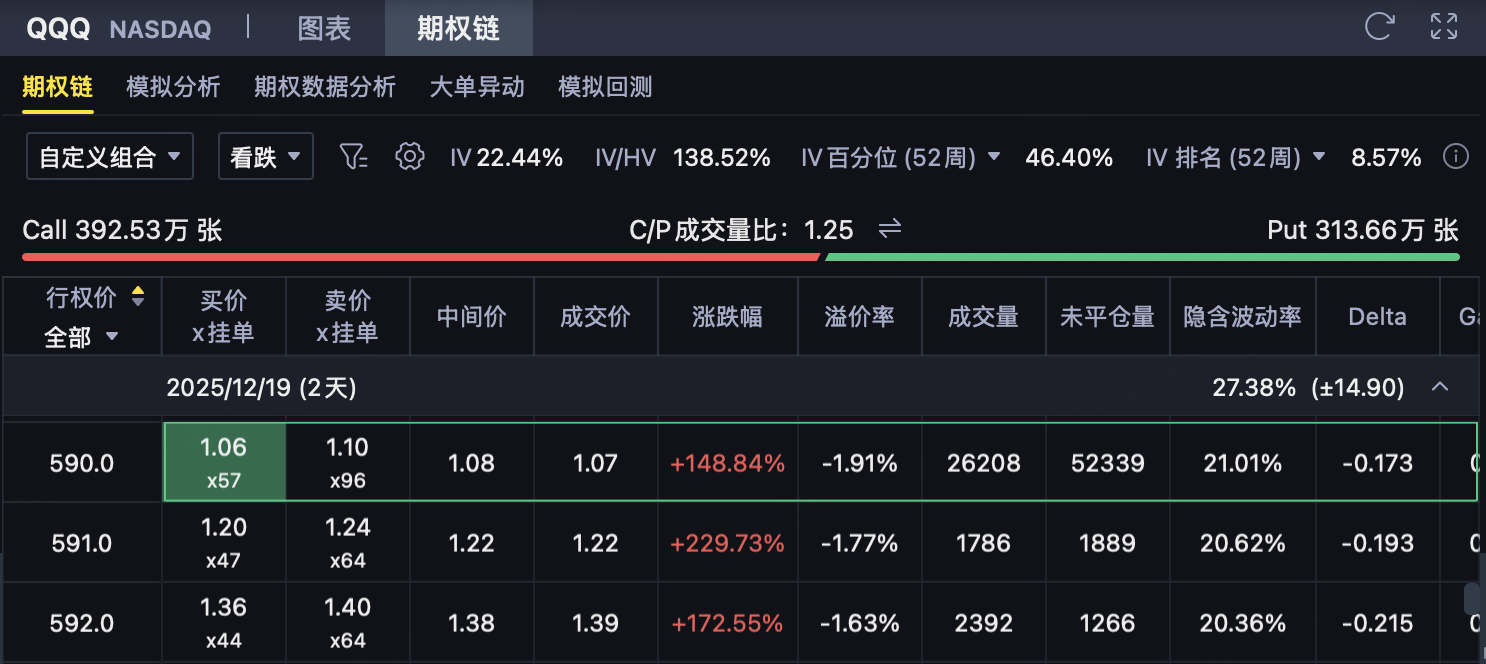
Buy Lower Strike PricePut: Investors buy the strike priceK ₁ = 585Put, Pay premium$0.58。
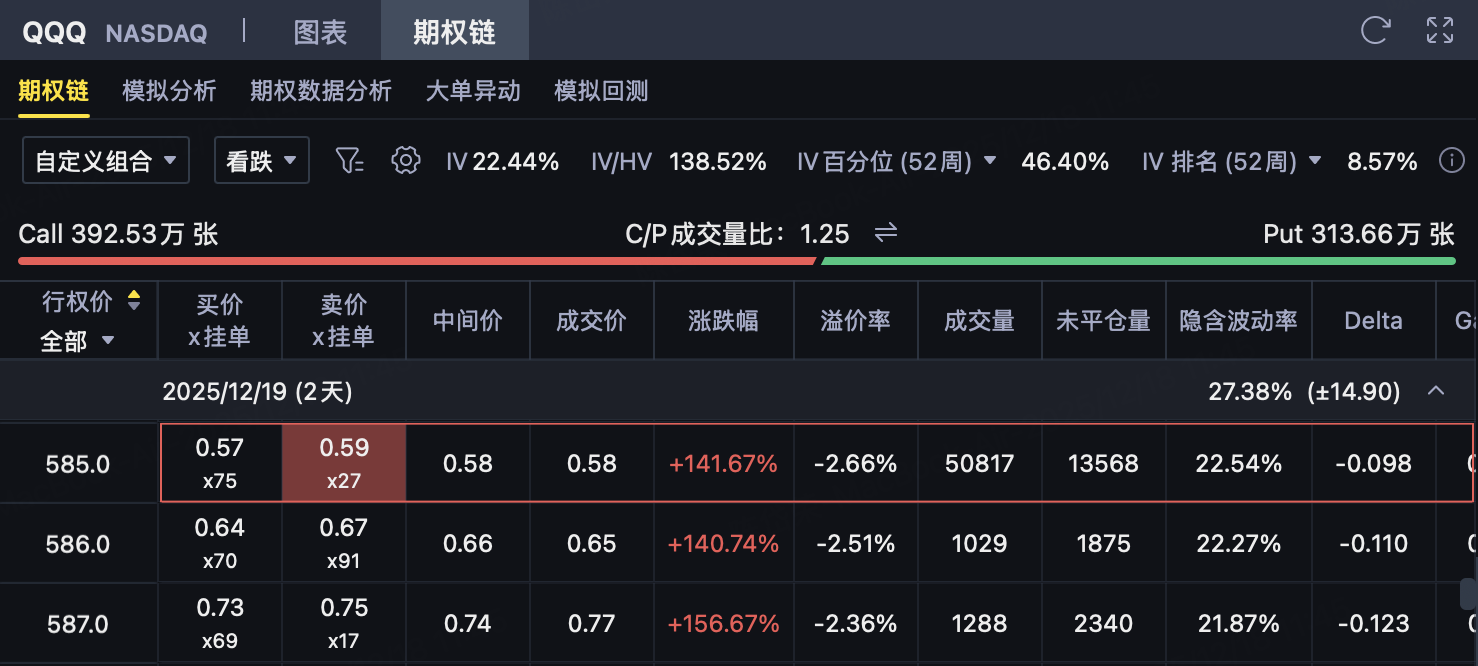
Put-side net income (per share): = 1.07 − 0. 58 =$0.49
This component is used to collect premium if the QQQ does not significantly fall below 590.
(2) Call side (bearish spread, bearish)
Sell Lower Strike Price Call: Investors sell the strike priceK ₃ = 610Call, collect premium$1.57。
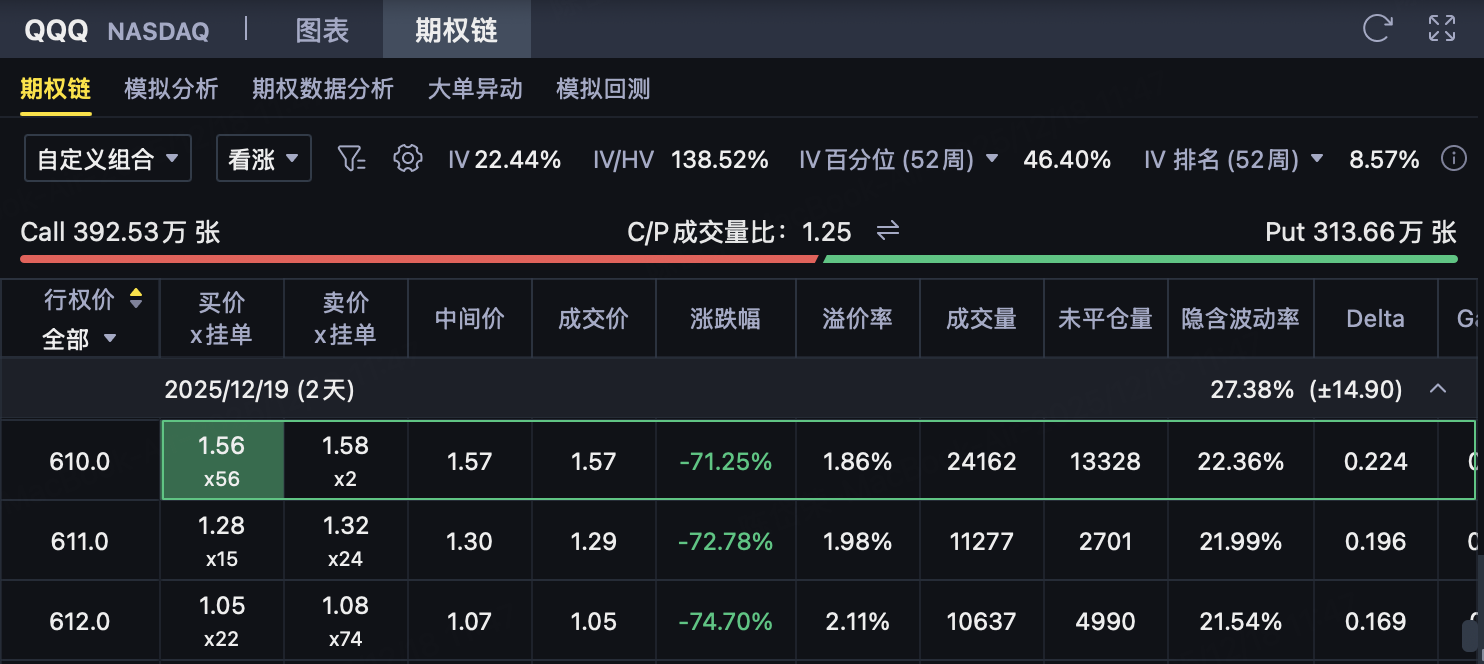
Buy Higher Strike PriceCall: Investors buy the strike priceK ₄ = 615Call, pay premium$0.55。
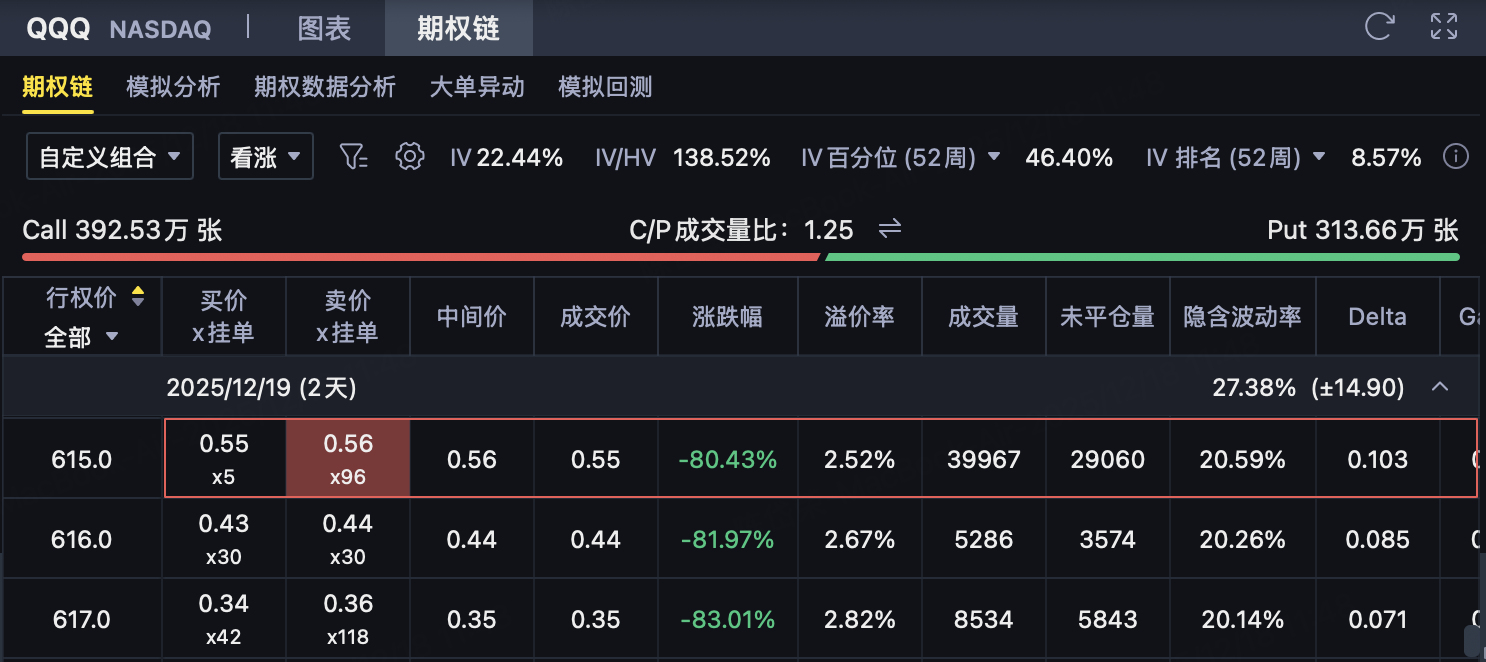
Call-side net income (per share): = 1.57 − 0.55 =$1.02
This portion is used to collect premium in the event that QQQ does not significantly break 610.
Initial net income
The total net premium of Iron Eagle Strategy is the sum of the net income of the Put side and the Call side:
Net premium (per share): = 0.49 + 1.02 =$1.51/Share
1 lot = 100 shares, so: the total net income obtained by investors when opening a position = 1.51 × 100 =$151/contract
This is also the largest potential profit of the strategy.
3. Maximum profit
When QQQ Expiration PriceBetween $590 and $610 inclusiveTime:
Both options on the Put side and Call side are out of the money
All four options go to zero
Maximum profit (per share): = Net premium received =$1.51
Maximum profit (per contract): = 1.51 × 100 =$151/contract
4. Maximum loss
The biggest loss of the Iron Eagle strategy occurs when the one-sided spread is fully triggered, that is, when the QQQ falls sharply or rises sharply.
One-sided strike spread:
= $5 (590 − 585 or 615 − 610)
Maximum loss (per share): = Strike spread − Net premium = 5 − 1.51 =$3.49/Share
Maximum loss (per contract): = 3.49 × 100 =$349/contract
Occurrences include:
QQQ expiration price ≤ US $585 (full price on the Put end)
Or QQQ expiration price ≥ 615 USD (full price on the Call side)
5. Break-even point
There are two break-even points in this Iron Eagle strategy:
Below break-even point: = Put sell strike price − Net premium = 590 − 1.51 =$588.49
Above break-even point: = Call sell strike price + net premium = 610 + 1.51 =USD 611.51
Maturity judgment rules:
Between US $588.49 ~ US $611.51→ Earnings for investors
= $588.49 or $611.51→ flat
≤ 588.49 or ≥ 611.51 USD→ Investor losses
6. Risk and return characteristics
Maximum benefit:$151/contract (limited)
Maximum loss: $349/contract (limited)
Profit-loss ratio: gain: loss ≈ 151: 349 ≈1: 2.31
Strategy features:
Receiving time value as the core
Limited bilateral risks and clear structure
The requirements for direction judgment are lower, but the requirements for volatility and price range judgment are higher
Applicable scenario: When investors expectQQQ maintains range-bound ahead of expiration date, neither will fall below 590 significantly, nor will it rise sharply to break through 610. I hope that under the premise of clarifying the maximum risk, when obtaining premium returns by selling the option portfolio, this selling iron eagle strategy has strong practicality..
Comments