When the growth rate begins to fail to support the valuation, the myth needs to be rewritten.
After Bubble Mart announced its results for the second half of 2025, the company's share price plunged by more than 22% in a single day. Goldman Sachs, Morgan Stanley and UBS, three major investment banks, simultaneously lowered their profit forecasts and target prices, and Wall Street's repricing of the Labubu founder's "high-speed growth" narrative officially started.
According to the latest financial report data, Bubble Mart's revenue in the second half of 2025 increased by 174% year-on-year to RMB 23.2 billion, and its net profit increased by 272% year-on-year to RMB 8.2 billion, but it was lower than Goldman Sachs' expectation of 8% and 10% respectively.
The core source of the performance gap is overseas markets-the year-on-year growth rate of the Americas in the second half of the year plummeted from more than 1265% in the third quarter to 633%, while that of Europe and other regions fell from more than 735% to 436%, both of which were significantly lower than expected. Hit by this, the stock price fell about 22% to 23% in a single day on March 25, and the Hang Seng Index rose 1% in the same period.
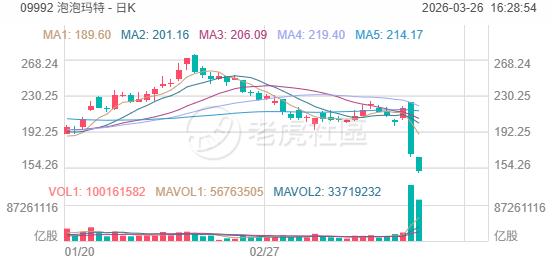
The three major investment banks immediately took action one after another. Goldman Sachs cut the company's 2026-2027 earnings forecast by 18%, slashed its 12-month price target from HK$300 to HK$184, and remained neutral. Morgan Stanley lowered its 2026-2027 revenue forecast by 4% to 5%, its net profit forecast by about 4%, and its target price from HK$ 325 to HK$ 278, but it stuck to its "overweight" rating and maintained its preferred stock status. UBS, for its part, lowered its adjusted net profit forecast for 2026 to 2028 by 7% to 13%, revised its price target from HK$326 to HK$278, and held its Buy rating unchanged.
The common judgment of the three institutions is that,Overseas expansion engines are cooling down, and short-term growth fluctuations will aggravate stock price fluctuations, but long-term IP ecological value can still support fundamentals. The core of the market controversy lies in whether the slowdown in growth rate is a temporary phenomenon brought by active operation adjustment, or the arrival of the inflection point of IP cycle after Labubu phenomenal heat peaked.
Overseas markets stalled, results missed expectations across the board
In the second half of 2025, Bubble Mart achieved total sales of RMB23.244 billion, representing a year-on-year increase of 174%; Net profit was RMB8,201 million, representing a year-on-year increase of 272%. The numbers remain bright, but here's the problem: Both are about 8% to 10% below Goldman's previous expectations.
From the perspective of regional structure, the actual performance of Greater China (including mainland China, Hong Kong, Macau and Taiwan Province) exceeded expectations, with a year-on-year increase of 134%, which was about 5% higher than Goldman Sachs' forecast; Asia Pacific was largely in line with expectations, growing 123% year-on-year.However, the performance of two core overseas markets has disappointed the market:
Americas market: year-on-year growth of 633%, which still seems to be an astronomical figure, but the growth rate in the third quarter was as high as 1,265%-1,270%, slowing down sharply from the previous quarter, and about 14% lower than Goldman Sachs' expectation;
Europe and other regions: growth of 436% year-on-year, which also slowed sharply from the growth rate of 735%-740% in the third quarter, and was 66% lower than Goldman Sachs' expectation.
Overseas sales were actually RMB 10.675 billion, compared with Goldman's previous estimate of RMB 13.231 billion, a gap of 19.3%. The gap in net profit was also partially dragged down by foreign exchange losses.
Goldman Sachs pointed out in a communication with investors,The market reaction mainly reflects concerns about the deceleration of growth, especially the third-party data in the US market showing a continuous deceleration year-to-date, and IP/product cycle risks.
Morgan Stanley said,Data from third-party sources shows that growth in the U.S. market is still slowing further year-to-date, one of the important drivers of the shift in investor sentiment to pessimism.
Three major investment banks disagree: the magnitude of downgrade and rating position vary
Despite the same lower-than-expected performance, the three investment banks have obvious differences in adjustment strength and rating position.
Goldman Sachs had the biggest correction. Analyst Michelle Cheng's team lowered its 2026-2027 earnings forecast by 18%, based on three judgments:
First, the selling prices of new products in the U.S. market are facing downward pressure due to the reduction of tariff rates;
Second, the high price of raw materials brings pressure on gross profit margin;
Third, the slowdown of overseas expansion weakened the operational leverage effect.
On the valuation side, Goldman Sachs lowered its target P/E from 20 times to 15 times, and switched the valuation reference frame to one standard deviation below Disney's 10-year historical average. The 12-month target price was sharply cut from HK$ 300 to HK$ 184, which is only about 9.3% upside from the current share price of HK$ 168.3, and the rating remained neutral.
Morgan Stanley is significantly more optimistic.
Analyst Dustin Wei's team lowered its target price from HK$325 to HK$278 and its target P/E from 26x to 23x (corresponding to a PEG of approximately 1.3x, based on a 22% CAGR of EPS from 2025 to 2027) after cutting its 2026-2027 earnings by approximately 4%, but stuck with an "overweight" rating and kept Bubble Mart on its top stock list.
Morgan Stanley believes that the current P/E of about 14 times 2026 is underestimated, and the company is "still expanding its share in an expanding global IP collectibles market", while the business adjustment efforts in 2026 are expected to further improve its competitiveness from 2027 to 2028.
UBS's correction was similarly relatively mild.
The bank lowered its adjusted net profit forecast for 2026 to 2028 by 7% to 13%, with the overseas forecast cutting significantly, but the domestic forecast was upgraded, with the target price lowered from HK$326 to HK$278, and the buy rating remained unchanged, seeing the current valuation as attractive.
There are also some differences in the revenue forecasts of the three institutions for 2026: Goldman Sachs forecasts 44.9 billion yuan (up about 21% year-on-year), Morgan Stanley forecasts 45.9 billion yuan (up about 24%), and UBS forecasts about 45 billion yuan (up about 21%).
While the three major investment banks jointly lowered their forecasts, there were significant differences in their judgments on the medium-and long-term prospects of Bubble Mart, reflecting the deep game of the market:
Goldman Sachs chose to take Disney's historical valuation as the anchor, believing that the current slowdown in growth rate should bring about the compression of valuation multiple. The uncertainty of recent IP/product cycle has limited the risk-return ratio of overweight positions, so it remains "neutral"; Morgan Stanley adheres to the long-term narrative of "the global IP collectibles market share is still expanding", comparing it to the early combination of "Sanrio + Bandai + Lego + Disney", believing that the current valuation is undervalued; From the perspective of fundamental growth, UBS is optimistic about the resilience of the Chinese market and maintains "buy".
Management Sets the Tone 2026: Consolidation Priority, Prudent Expansion
The signals released by the management at the results conference were generally prudent, actively positioning 2026 as the "year of operational consolidation and organizational optimization", and intentionally slowing down after significantly exceeding its expected high-speed growth in 2025, so as to consolidate the foundation for sustainable and healthy growth.
In terms of core performance guidance, the company has set a 2026 revenue growth target of no less than 20%, while committing not to sacrifice profitability. Given the uncertainty of raw material costs and logistics expenses, the gross margin specific guidance was postponed to disclosure at the May quarterly business update meeting. At the same time, the company announced the addition of quarterly business update mechanism in May and November each year to enhance operational transparency.
Morgan Stanley specifically pointed out in the research report,Management has taken the initiative to delay the opening pace of the Labubu 4.0 series and flagship stores in New York (Times Square and Fifth Avenue), believing that the relatively conservative growth target for 2026 stems in part from the company's proactive management, rather than simply slowing market demand.
From the perspective of operational layout, the focus of the domestic market will shift to store renovation. The number of stores planned to be renovated will exceed 2025, and several new flagship stores will be opened (the management said that the store efficiency of the upgraded stores will double in 2025, and the area will be expanded by 30% to 50%).
Overseas, the management plans to exceed 100 stores in the United States by 2026, while focusing on low-to mid-tier cities and white markets such as popular tourist destinations (e.g. Pattaya, Bali) and international hub airports (e.g. Narita, Doha).
It is worth noting that in 2025, the proportion of overseas online channels exceeded that of offline stores for the first time. According to the management, the high proportion of online sales in the United States mainly reflects the pressure of offline channel operation. In the long run, the offline proportion will gradually pick up, but it may still be mainly online in 2026.
Comments