Shares of stablecoin issuer Circle tumbled 20.11% on Tuesday to close at $101.17, marking the worst single-day decline in the company’s history. The selloff followed the release of a revised cryptocurrency bill, known as the “Clarity Act,” which posts potential restrictions on yields generated from stablecoin balances.
Prior to Tuesday, the stock’s largest drop came on June 27, 2025, when it fell 15.5%. The decline also dragged down Coinbase , a key distribution platform for USDC, with its shares falling 9.8%.
Yield generation—typically offered as rewards—has been a key incentive for holding stablecoins such as Circle’s USDC, functioning similarly to interest on bank deposits. Critics argue that if crypto platforms like Coinbase continue offering such yields, it could draw deposits away from the traditional banking system.
Options Market Indicators
Implied Volatility and Volume Overview
Implied Volatility (IV): 98.30%
IV Percentile: 68.84%
IV/HV Ratio: 0.78
Put/Call Volume Ratio: 1.52
Circle’s implied volatility stands at an elevated 98.30%, indicating that the market is pricing in significant price swings. The IV percentile of 68.84% places it in a moderately high range, suggesting options are relatively expensive and sentiment remains tense.
Open Interest Analysis
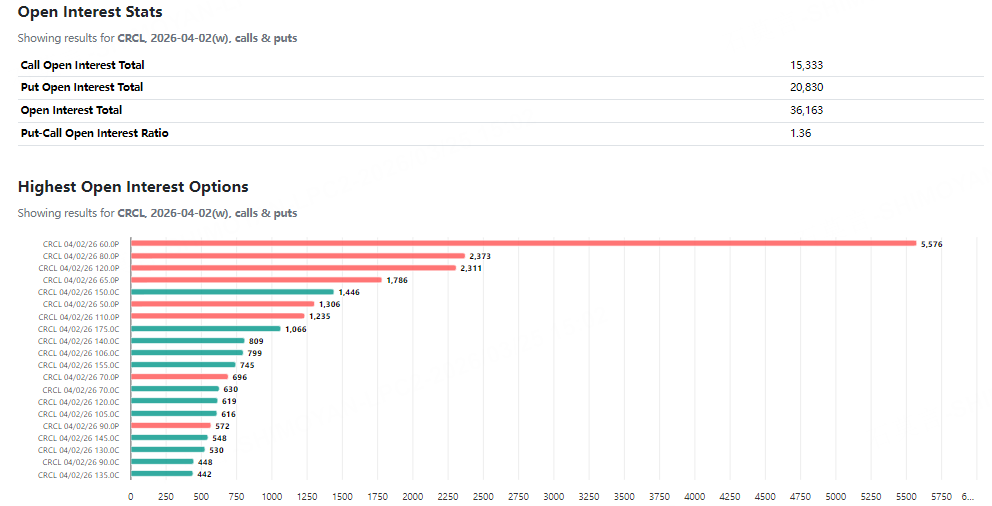
For near-term contracts expiring April 2, total put open interest significantly exceeds calls, with a put/call OI ratio of 1.36, pointing to concentrated hedging or bearish positioning in the short term.
In contrast, for slightly longer-dated contracts expiring April 10, call open interest surpasses puts, with a put/call OI ratio of 0.54, suggesting some investors are positioning for a rebound or improved outlook over a longer horizon.
Block Trades: Coexistence of Near-Term Hedging and Long-Dated Bullish Positioning
Near-term downside hedge:
A block trade last week involved the purchase of 10,000 put options expiring March 27 with a $72 strike. Despite relatively low premium costs, these deep out-of-the-money puts may serve as low-cost “black swan” protection against extreme downside risk.
Source: Tiger Trade App
Most notable bullish position:
A separate block trade saw the purchase of 5,487 call options expiring in September 2026 with an $80 strike, with a total premium of about $32.7 million. This represents a sizable long-term directional bet, indicating that some investors are willing to pay a high premium to position for a sharp upside move in Circle shares over the coming months.
Source: Tiger Trade App
Seller positioning:
Observed block sell trades largely involve selling out-of-the-money options to capture time decay, reflecting mildly bullish or neutral strategies. Examples include selling $80 puts expiring April 2 and $117 calls expiring this Friday.
Source: Tiger Trade App
Strategy Takeaways
For investors seeking to collect premiums, the elevated volatility environment suggests that selling deep out-of-the-money options—such as puts below $80 or calls above $130—may carry a relatively low probability of assignment. However, tail risks should not be overlooked.
To limit margin requirements and cap potential losses, traders may consider spread strategies, such as pairing short out-of-the-money options with further out-of-the-money options in the same direction to define maximum risk exposure.
Disclaimer: Options trading involves significant risk. The above analysis is for informational purposes only and does not constitute investment advice. Investors should fully understand the characteristics of options and make decisions based on their own risk tolerance.
Comments